A Threat Actor "team" is an organized group of individuals with specialized skills collaborating to carry out cyber attacks. Red Teams apply the same techniques but with the intention to secure the company instead of harming it. Unlike cybersecurity professionals who protect systems (like the Blue Team), these teams are the adversaries aiming to breach defenses for malicious purposes.
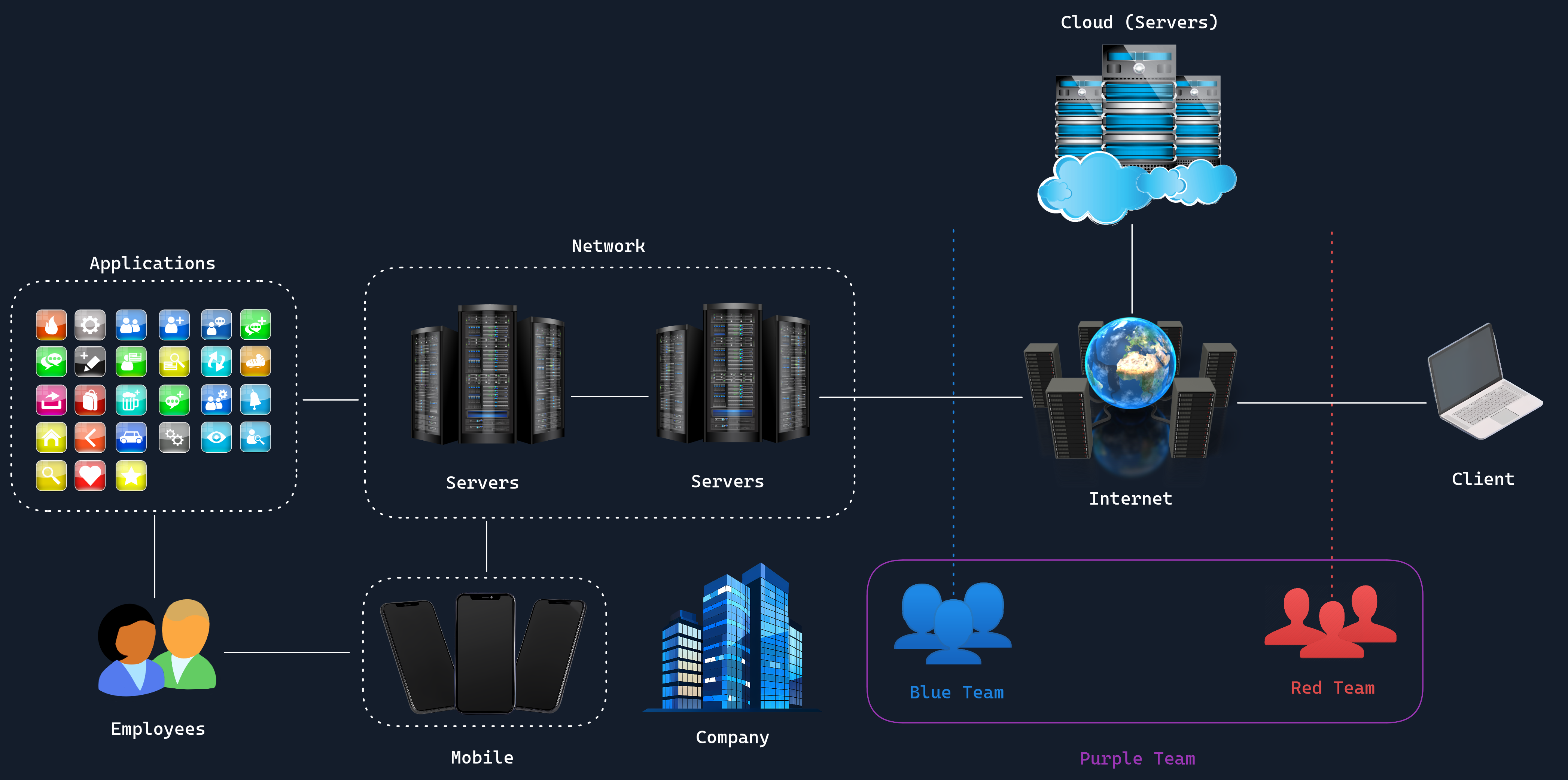
A Threat Actor (team) comprises several key members, each with specialized skills crucial for executing cyber attacks. Expert Programmers create custom malware to exploit system vulnerabilities, while Network Specialists navigate complex digital infrastructures to find weak points. Social Engineers use psychological manipulation techniques to deceive individuals into revealing sensitive information. Data Analysts process stolen information to extract valuable intelligence, such as financial details or trade secrets. Overseeing these operations are Team Leaders, who coordinate activities, set objectives, and devise strategies for successful attacks. This diverse skill set allows Threat Actor Teams to carry out sophisticated cyber operations efficiently and effectively.
A threat actor can also be an individual operating independently. These solo actors, often referred to as lone wolves, possess a diverse skill set that allows them to execute cyber attacks without the support of a team. They may be motivated by personal interests, financial gain, or ideological beliefs. While individual threat actors might lack the resources of larger groups, their ability to work autonomously can make them equally dangerous and sometimes more challenging to detect. Their methods can range from simple phishing attempts to sophisticated malware development, depending on their expertise and objectives.
Imagine a cybersecurity threat actor team as a group of highly skilled burglars planning a heist on a high-security bank. Each member has a unique role, just as a hacker team has specialized individuals. There’s a scout, who surveys the bank, studying the layout, security guards, and timing of patrols much like a cyber threat actor who performs reconnaissance, gathering information about a target’s vulnerabilities, system configuration, or employee habits. Then there’s the lockpicker, who specializes in bypassing physical locks, doors, and alarms; in a cybersecurity team, this role aligns with the person focused on exploiting software or network vulnerabilities, using tools to infiltrate the system without triggering alarms. The getaway driver, on the other hand, plans the escape route, ensuring they don’t leave a trace or set off any pursuit.
In the cyber world, this is the role of the exfiltration specialist, who safely extracts data or deploys ransomware while evading detection, covering their tracks meticulously. Finally, there's the leader or strategist who brings everyone together, coordinating their actions and planning each phase in detail, ensuring all efforts align toward a successful heist.
To execute this heist, they use specific tools and techniques designed for precision and stealth.
- The scout might use high-powered binoculars or blueprints, just as a cyber reconnaissance specialist uses tools like network scanners, open-source intelligence gathering (OSINT), and social engineering to probe weak points.
- The lockpicker may have specialized tools, like lock picks and code breakers, similar to the hacker’s malware, rootkits, or custom scripts used to gain unauthorized access.
- The getaway driver relies on knowledge of the roads, perhaps even tampering with streetlights, which mirrors the exfiltration specialist’s use of encrypted communication channels, data obfuscation techniques, and VPNs to remain untraceable.
- The leader coordinates with secure radio communication and may avoid the use of overly complex equipment that could slow down or complicate the heist.
Similarly, cybersecurity threat actors avoid using detectable or high-risk tactics that could easily alert security teams. They refrain from "noisy" hacking methods, like brute-force attacks that might trigger alarms, or obvious malware that is likely to be caught by antivirus programs. Instead, they focus on "low and slow" methods, taking their time to avoid detection, infiltrating systems subtly rather than in an aggressive, attention-drawing way.
Objectives
The primary objective of a Threat Actors is to infiltrate and exploit target systems or networks, with their motivations spanning a wide spectrum. Financial gain is a common driver, involving the theft of money through fraudulent transactions or the acquisition of valuable data for sale on the dark web. Espionage is another significant motive, where these teams gather confidential information from governments or corporations to gain strategic advantages.
Some threat actors focus on disruption, aiming to cause chaos by shutting down services, deleting data, or spreading misinformation. Ideological goals also play a role, with some teams promoting political, religious, or social causes by targeting organizations that oppose their beliefs. Lastly, revenge can be a powerful motivator, leading threat actors to attack entities as retaliation for perceived wrongs. This diverse range of motives underscores the complex and multifaceted nature of cyber threats in today's digital landscape.