ColdFusion is a programming language and a web application development platform based on Java. ColdFusion was initially developed by the Allaire Corporation in 1995 and was acquired by Macromedia in 2001. Macromedia was later acquired by Adobe Systems, which now owns and develops ColdFusion.
It is used to build dynamic and interactive web applications that can be connected to various APIs and databases such as MySQL, Oracle, and Microsoft SQL Server. ColdFusion was first released in 1995 and has since evolved into a powerful and versatile platform for web development.
ColdFusion Markup Language (CFML) is the proprietary programming language used in ColdFusion to develop dynamic web applications. It has a syntax similar to HTML, making it easy to learn for web developers. CFML includes tags and functions for database integration, web services, email management, and other common web development tasks. Its tag-based approach simplifies application development by reducing the amount of code needed to accomplish complex tasks. For instance, the cfquery tag can execute SQL statements to retrieve data from a database:
  SELECT *
  FROM myTable
Developers can then use the cfloop tag to iterate through the records retrieved from the database:
#myQuery.firstName# #myQuery.lastName#
Thanks to its built-in functions and features, CFML enables developers to create complex business logic using minimal code. Moreover, ColdFusion supports other programming languages, such as JavaScript and Java, allowing developers to use their preferred programming language within the ColdFusion environment.
ColdFusion also offers support for email, PDF manipulation, graphing, and other commonly used features. The applications developed using ColdFusion can run on any server that supports its runtime. It is available for download from Adobe's website and can be installed on Windows, Mac, or Linux operating systems. ColdFusion applications can also be deployed on cloud platforms like Amazon Web Services or Microsoft Azure. Some of the primary purposes and benefits of ColdFusion include:
Despite being less popular than other web development platforms, ColdFusion is still widely used by developers and organisations globally. Thanks to its ease of use, rapid application development capabilities, and integration with other web technologies, it is an ideal choice for building web applications quickly and efficiently. ColdFusion has evolved, with new versions periodically released since its inception.
The latest stable version of ColdFusion, as of this writing, is ColdFusion 2021, with ColdFusion 2023 about to enter Alpha. Earlier versions include ColdFusion 2018, ColdFusion 2016, and ColdFusion 11, each with new features and improvements such as better performance, more straightforward integration with other platforms, improved security, and enhanced usability.
Like any web-facing technology, ColdFusion has historically been vulnerable to various types of attacks, such as SQL injection, XSS, directory traversal, authentication bypass, and arbitrary file uploads. To improve the security of ColdFusion, developers must implement secure coding practices, input validation checks, and properly configure web servers and firewalls. Here are a few known vulnerabilities of ColdFusion:
- CVE-2021-21087: Arbitrary disallow of uploading JSP source code
- CVE-2020-24453: Active Directory integration misconfiguration
- CVE-2020-24450: Command injection vulnerability
- CVE-2020-24449: Arbitrary file reading vulnerability
- CVE-2019-15909: Cross-Site Scripting (XSS) Vulnerability
ColdFusion exposes a fair few ports by default:
It's important to note that default ports can be changed during installation or configuration.
Enumeration
During a penetration testing enumeration, several ways exist to identify whether a web application uses ColdFusion. Here are some methods that can be used:
NMap ports and service scan results
sasorirose@htb[/htb]$ nmap -p- -sC -Pn 10.129.247.30 --open

Starting Nmap 7.92 ( https://nmap.org ) at 2023-03-13 11:45 GMT
Nmap scan report for 10.129.247.30
Host is up (0.028s latency).
Not shown: 65532 filtered tcp ports (no-response)
Some closed ports may be reported as filtered due to --defeat-rst-ratelimit
PORT      STATE SERVICE
135/tcp   open  msrpc
8500/tcp  open  fmtp
49154/tcp open  unknown

Nmap done: 1 IP address (1 host up) scanned in 350.38 seconds
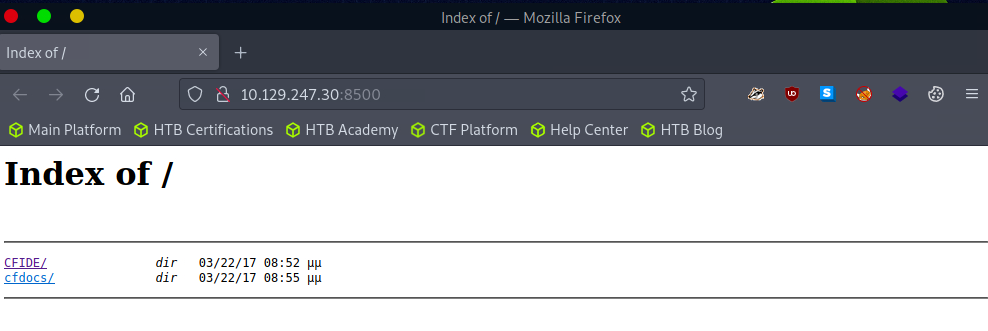
The port scan results show three open ports. Two Windows RPC services, and one running on 8500. As we know, 8500 is a default port that ColdFusion uses for SSL. Navigating to the IP:8500 lists 2 directories, CFIDE and cfdocs, in the root, further indicating that ColdFusion is running on port 8500.
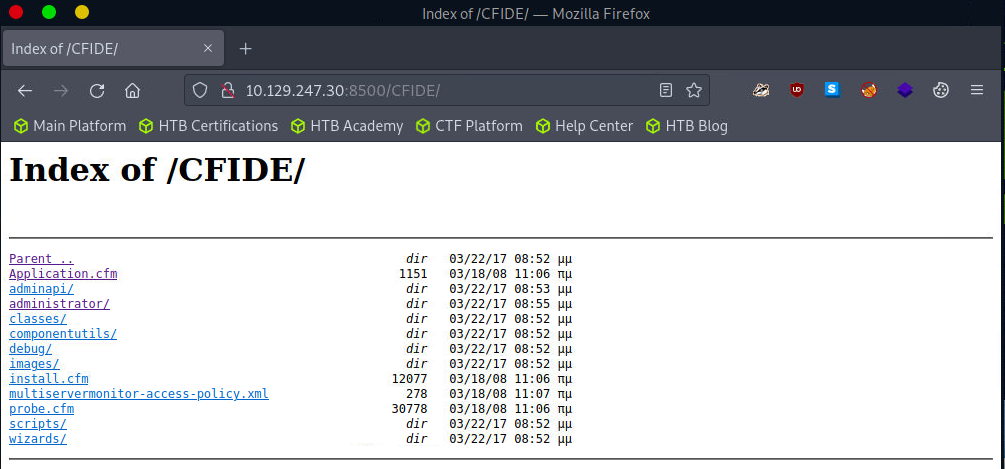
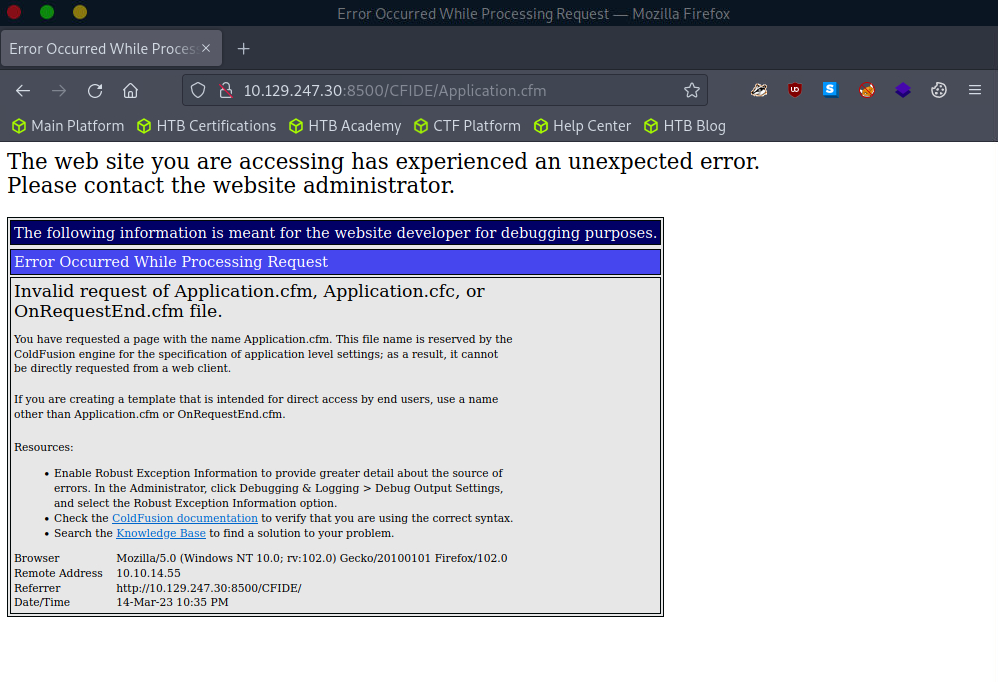
Navigating around the structure a bit shows lots of interesting info, from files with a clear .cfm extension to error messages and login pages.
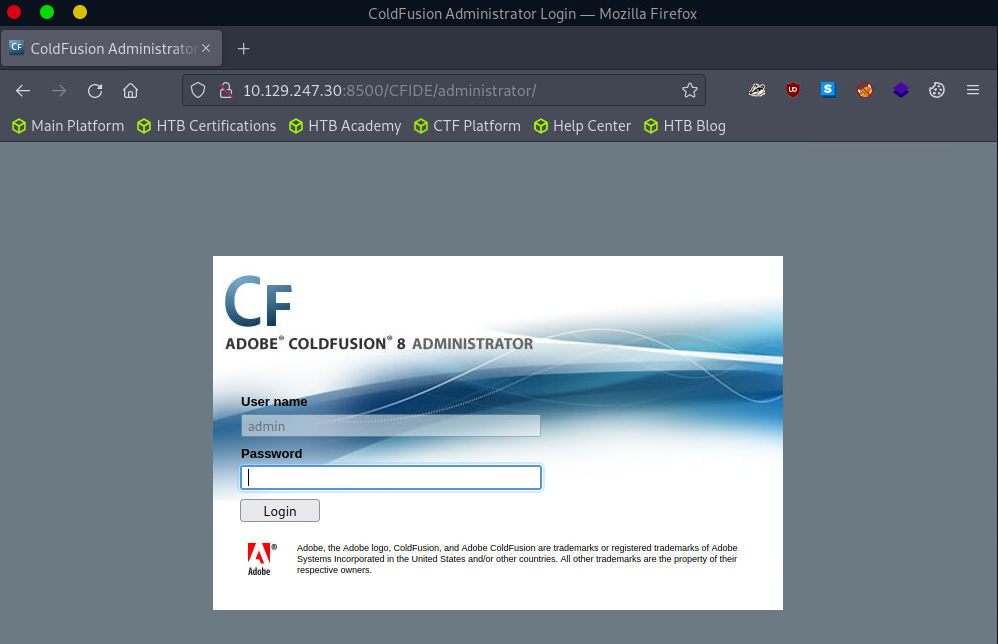
The /CFIDE/administrator path, however, loads the ColdFusion 8 Administrator login page. Now we know for certain that ColdFusion 8 is running on the server.
Questions:
What ColdFusion protocol runs on port 5500?
Answer: Server Monitor